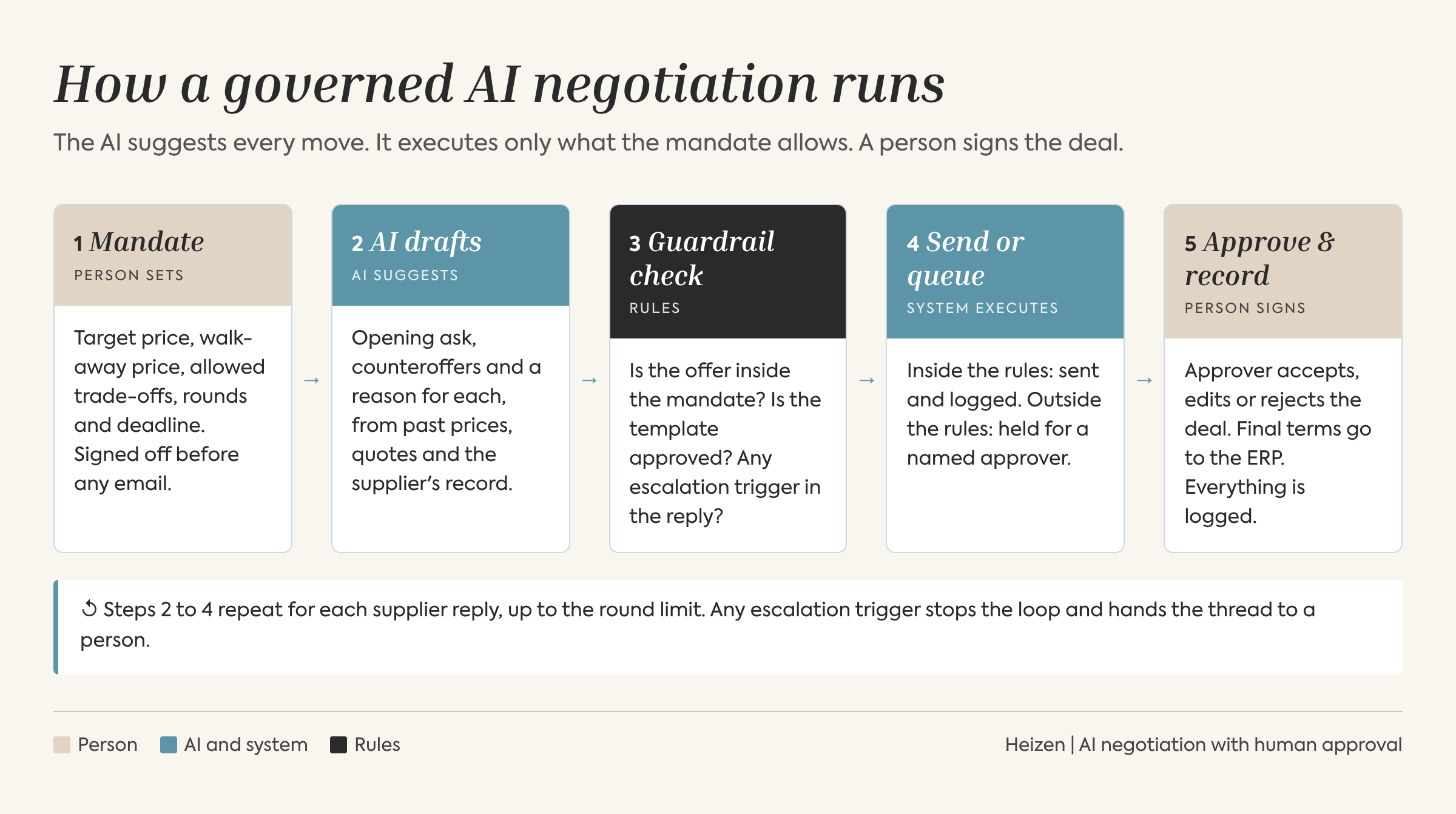
Yes. AI can negotiate supplier prices with human approval, and some of the world's largest buyers already do it. In AI supplier negotiation with human approval, software drafts offers and talks to suppliers inside limits your team sets: a target price, a walk-away price, allowed trade-offs and a deadline. Anything outside those limits, and any deal above an approval threshold, waits for a named person to sign off. Every message and decision is logged.
Heizen builds this kind of custom procurement AI with human approval around a company's own approval rules, mailboxes and ERP. This guide explains what the AI can propose, what it should never do on its own, and how to set the guardrails, thresholds and audit log.
Why are procurement teams asking AI to negotiate with suppliers?
Picture a category manager at a plant in Pune in December. 140 supplier contracts renew in January, and she has time to negotiate perhaps 15 of them properly. The other 125 roll over at last year's price, or at whatever increase the supplier asks for.
· The tail is big in count, small in value. Hundreds of suppliers each take a small share of spend, so nobody negotiates with them.
· Workload grows faster than teams. The Hackett Group's 2025 Key Issues study found procurement workload rising 10% while budgets rose just 1%.
· Analysts expect AI to fill the gap. In May 2024, Gartner predicted that by 2027, 50% of organizations will support supplier contract negotiations with AI-enabled contract risk analysis and editing tools.
So the real question for most CPOs is not whether AI can negotiate. It is how to let it negotiate without losing control.
What happened when companies let AI negotiate with suppliers?
Most published results come from Pactum, the best-known autonomous negotiation vendor, and its customers. They show both what works and where people stayed in charge.
Table 1. Published results from AI and automated supplier negotiation, as reported by Harvard Business Review (2022, 2025) and MIT Sloan Management Review.
What these AI negotiation case studies show
· Narrow scope works. Every success started with non-strategic, repeatable categories, not key suppliers.
· Suppliers will negotiate with a bot. In follow-up surveys, 83% of Walmart's suppliers liked being able to counteroffer.
· Savings per deal are modest, but new. 1.5% on spend nobody negotiated before was money left on the table.
· People never left. They moved from typing emails to setting the mandate and approving deals.
What can AI propose in a supplier negotiation?
First, separate two words: suggest and execute. A suggestion is a draft a person can change or ignore. An execution changes something outside the company: an email reaches a supplier, a price is agreed, or the ERP is updated.
What can AI suggest ?
· An opening ask, based on past prices and the lowest comparable landed cost from your comparison of supplier quotations.
· Counteroffers and trade-offs, such as a lower price in return for a 12-month price hold, free freight or faster payment.
· A one-page brief for the buyer, with the supplier's history and its score from your supplier evaluation scorecard.
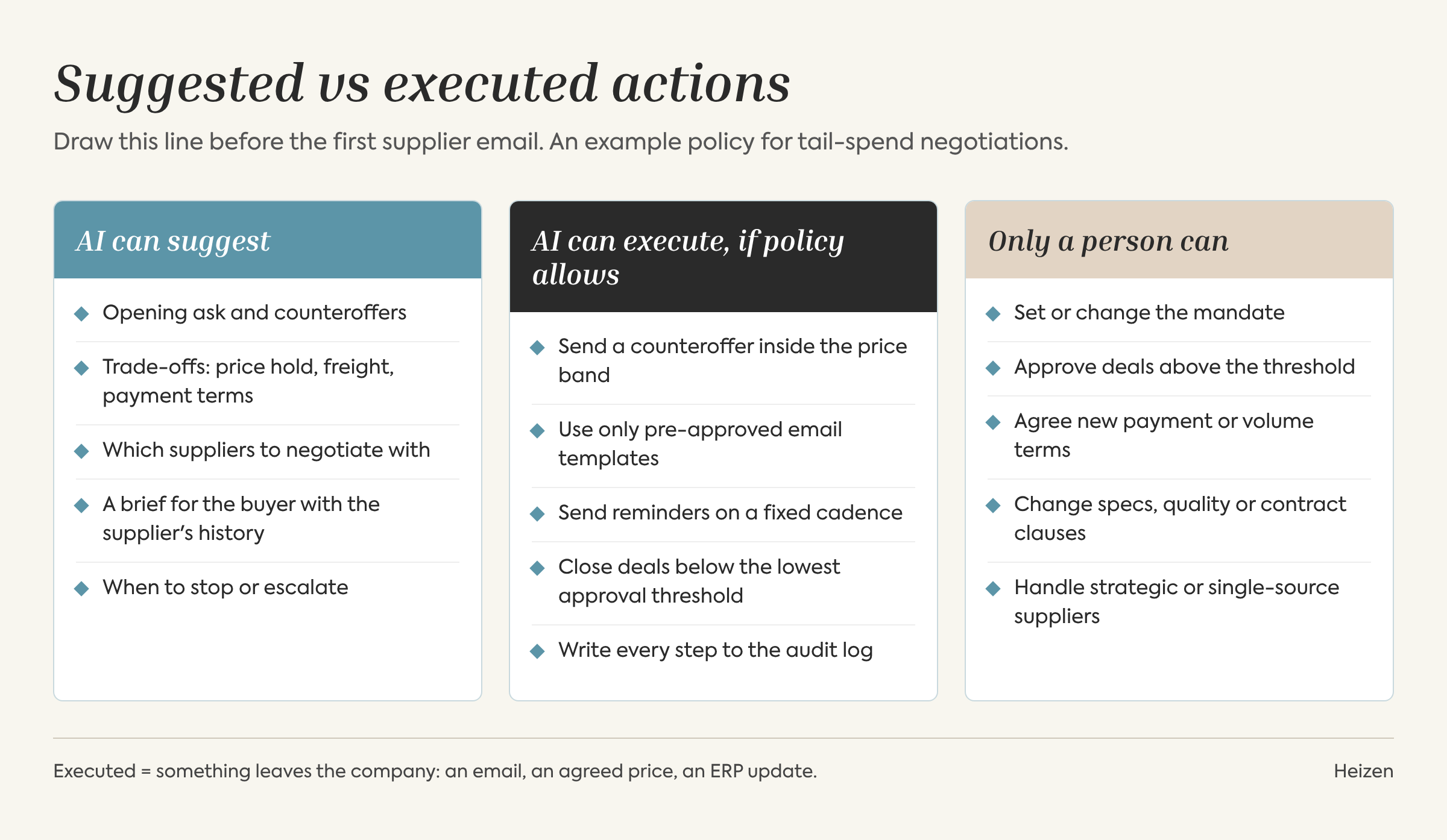
Suggested vs executed actions: an example policy for tail-spend negotiations.
Table 2. Suggested vs executed actions in a governed AI negotiation (example policy).
What commercial guardrails should an AI negotiation follow?
Guardrails are the negotiation mandate. A person sets them before the first email, and the AI cannot change them. This example uses the ball-bearing order from our worked example, where Supplier A won at ₹37.00 a piece (test data).
Table 3. Example negotiation guardrails (test data).
How to set guardrails that hold up ?
· Use landed cost, not headline price. Our free supplier quote comparison template shows how to get there.
· Clean the supplier master first. Duplicate vendor codes give the AI the wrong price history.
· Keep strategic, single-source and at-risk suppliers out. These need people, not software.
How should approval thresholds work for AI-negotiated deals?
Thresholds decide who signs. Most companies already have a delegation of authority (DoA) matrix for purchase orders. Use the same matrix for AI-negotiated deals, so approvers see nothing new.
Table 4. Example approval thresholds for AI supplier negotiation. Set your own from your DoA matrix.
In our example, the AI and Supplier A settle at ₹36.20 a piece with a 12-month price hold. On 60,000 pieces a year, that is about ₹21.7 lakh of spend, so it is a Tier 1 deal and the buyer must approve it. The saving is ₹48,000 a year.
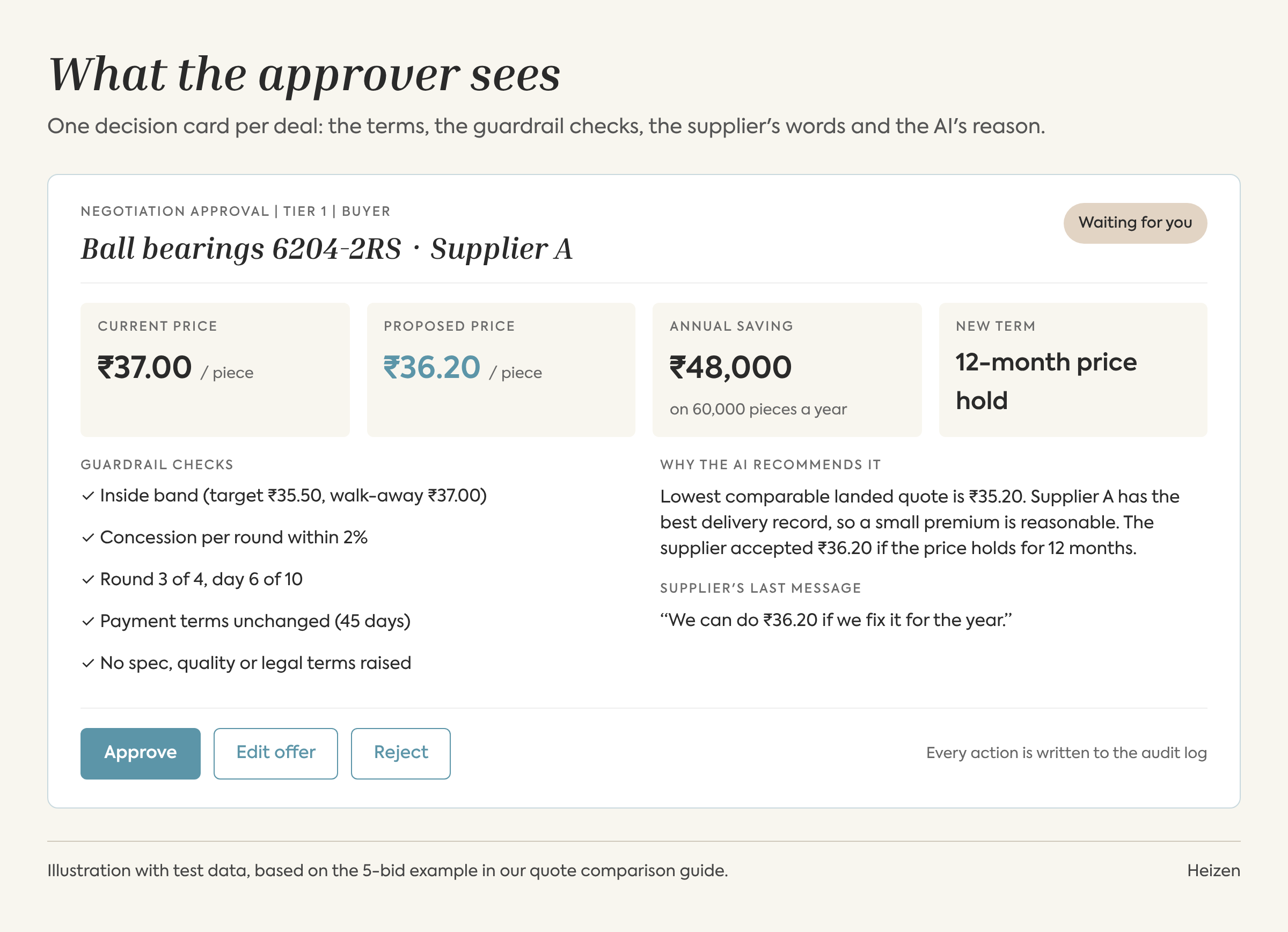
What the approver sees: one decision card per deal (illustration, test data).
What should an AI negotiation email never do?
Email is where AI negotiation meets the outside world, so write its boundaries down.
· Say that it is AI-assisted, and send from a named team mailbox with a real person as the reply-to. GEP advises that companies "let suppliers know when they're interacting with an AI agent".
· Never invent a competing bid or a deadline. Never name another supplier or share its price.
· Make no legal, volume or exclusivity promises that are not in the mandate.
· Stop when asked. If a supplier asks for a person or says stop, the thread goes to the buyer that day.
What should the negotiation audit log record?
Researchers Elena Revilla and María Jesús Sáenz put the accountability point plainly: "If an AI tool makes a mistake, like incorrectly assessing a supplier, the company, not the software, is responsible." The audit log is how the company shows what happened.
· The mandate: its version, who set it and who approved it.
· Every message, in and out, with the time it was sent or received.
· The AI's reason for each offer, and the rule that allowed it to be sent.
· Every approval: who approved, when, and what they changed.
· The outcome: final terms, the ERP update and any escalation. This also gives you the baseline to measure RFQ automation ROI.
When should AI escalate a supplier negotiation to a person?
Table 5. Escalation examples for AI supplier negotiation.
Some of these cases suit an experienced negotiator or adviser better than any software.
Should you buy an AI negotiation platform or build around your process?
· A ready-made platform fits if you have thousands of tail suppliers, standard terms, and you are happy with the vendor's approval model.
· A custom build fits if approvals must follow your own DoA, negotiations run from your team's mailboxes, or your ERP and data are not standard.
Frequently asked questions (FAQs)
Can AI negotiate supplier prices without any human approval?
Technically yes, for small deals inside agreed limits. Most companies still require human approval above a threshold and keep strategic suppliers and contract terms with people.
Who is responsible if an AI negotiation agent agrees a bad deal?
The company is. That is why AI supplier negotiation needs a signed mandate, approval thresholds and a full audit log of every message and decision.
Which supplier negotiations are suitable for AI?
Repeat purchases from non-strategic suppliers with standard terms: indirect spend, MRO, packaging and renewals. Strategic, single-source and legally complex negotiations should stay with people.
How much can AI supplier negotiation save?
Published results range from 1.5% average savings in Walmart's pilot to 7% to 8% at Maersk against manual negotiation. Results depend on the category and how much of it was negotiated before.
Conclusion
AI can negotiate supplier prices, and it works best with clear limits. Let it suggest freely, let it execute only what your policy allows, and keep a named person on every deal above your threshold. With guardrails, thresholds, email boundaries and an audit log, AI negotiation with human approval reaches spend your team never had time for, without giving up control.
Sources
· Remko Van Hoek, Michael DeWitt, Mary Lacity and Travis Johnson, "How Walmart Automated Supplier Negotiations", Harvard Business Review, November 2022. Figures as summarised by Talking Logistics (1 May 2023): https://talkinglogistics.com/2023/05/01/negotiating-with-a-chatbot-a-walmart-procurement-case-study/
· MIT Sloan Management Review, "Procurement in the Age of Automation": https://sloanreview.mit.edu/article/procurement-in-the-age-of-automation/
· Elena Revilla and María Jesús Sáenz, "How AI Is Reshaping Supplier Negotiations", Harvard Business Review, July 2025, via MIT CTL (28 Jul 2025): https://ctl.mit.edu/news/how-ai-reshaping-supplier-negotiations
· Gartner, "Gartner Predicts Half of Procurement Contract Management Will Be AI-Enabled by 2027" (8 May 2024): https://www.gartner.com/en/newsroom/press-releases/2024-05-08-gartner-predicts-half-of-procurement-contract-management-will-be-ai-enabled-by-2027
· The Hackett Group, 2025 Procurement Key Issues study (press release, 10 Apr 2025).
· GEP, "Can AI agents pull off supplier negotiations?" (18 Mar 2026): https://www.gep.com/blog/technology/can-ai-agents-pull-off-supplier-negotiations
· Heizen case studies: https://www.heizen.work/case-studies