Custom AI procurement automation means AI agents built around a company's own purchasing process, approval rules and systems, instead of a packaged tool that every customer uses the same way. These custom procurement AI agents work inside the ERP, email and spreadsheets a team already uses. They handle supplier quote comparison, RFQ follow-ups and data entry, while people keep the final say on every purchase.
Heizen builds custom AI procurement automation for companies whose buying process doesn't fit off-the-shelf software. We map how the team actually buys, then build AI agents that connect to SAP, Oracle, supplier portals and the company's approval systems. Most projects go live in 6 to 8 weeks, and the company owns the finished system.
Understanding with an example
Picture a Thursday at 4 pm. A buyer has five supplier quotes to compare, and each one arrived differently: a scanned PDF, an email reply, two spreadsheets with different columns, and one priced in euros with freight still “to be confirmed”. The purchase order has to be in SAP by the end of the day. This is exactly the kind of work custom AI procurement automation takes off a team's plate.
Why does procurement still run on email and spreadsheets?
Most large companies have invested heavily in their ERP. On paper, the procure-to-pay process is digital. However day to day, much of the work still happens between systems.
Quotes come in every format. Suppliers reply to whichever thread they find first. The purchase approval workflow sits partly in SAP and partly in the head of someone who has been in the team for years. Deloitte's 2025 Global Chief Procurement Officer Survey, which covered more than 250 CPOs in 40 countries, found that siloed ways of working were the most common barrier to delivering value, cited by 57% of respondents.
In practice, that looks like this:
- Buyers spend their days chasing missing quotes, retyping prices and updating trackers. Supplier relationships and better terms get whatever time is left at the end of the week.
- Small errors get through. A duplicate order, a price that crept up, an invoice that doesn't match the PO. These problems that slip through between RFQ and PO tend to surface late, if they surface at all.
- Every new tool comes with its own logins, its own data and its own training. After a while the team is managing software instead of suppliers.
The people are rarely the problem. Most procurement software was designed around a standard process, and very few companies actually have one.
What are the usual procurement automation options?
Teams looking at AI procurement automation usually weigh three options, and each one suits some companies well.
A full procurement suite. Coupa and SAP Ariba handle catalogue buying, supplier portals and spend reporting well, and many suites now include AI agents for procurement. The trade-off is that your process has to fit the suite, not the other way round. Suppliers need to use the portal, and the unusual parts of the process often drift back into Excel.
A tool for one step. There is good procurement automation software for single jobs such as intake, RFQ automation or quote comparison. These tools start quickly, but each one is another system to keep in sync, and none of them knows your company's approval rules.
Better spreadsheets or outside help. A sharper sheet, like our free supplier quote comparison template, or a consulting project can help a lot, and there are cases where a procurement consultant is the better choice. The daily work usually stays manual, though
A fourth option is to keep your systems and your process, and build AI around them. Here is how the four compare:
How does custom AI procurement automation work?
Custom AI procurement automation starts with your process rather than a product. Heizen first looks at how your team actually buys: where quotes come from, who approves what, and which steps eat the most hours. We then build custom procurement AI agents for the step that matters most and connect them to the tools you already use. Your ERP stays the system of record, so this is procurement automation without replacing your ERP.
What can custom procurement AI agents do?
- Supplier intelligence. Bring together what you know about each supplier from the ERP, the inbox and old spreadsheets, so the last price paid or the last late delivery is a click away instead of a search through email.
- Vendor selection. Help you choose vendors even when your ERP data is messy, scored against your own supplier evaluation scorecard. Each score shows its reasons, which makes the decision easy to explain to finance.
- Negotiation support. Prepare counter-offers and talking points within limits you set. A person approves before anything goes to the supplier, as we explain in AI negotiation with human approval
- Procurement workflow automation. Run routine steps such as RFQ outreach and automated supplier follow-ups on schedule, so your team only steps in when a supplier needs a real conversation.
- Anomaly detection. Catch duplicate purchase requests, sudden price jumps and mismatched orders before money is spent, rather than during an audit months later.
- Operational benchmarking. Show where time and money go across the process, so you can decide what to improve next.
What does a typical project look like ?
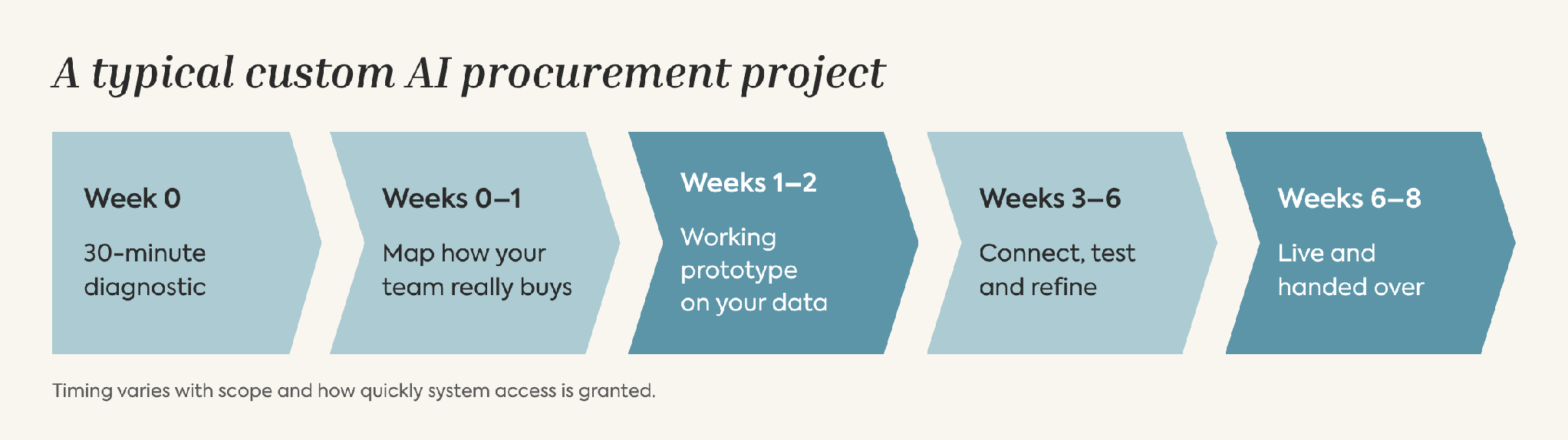
Most projects follow the same path. A free 30-minute diagnostic finds the step worth automating first. We then map how the work really flows, build a working prototype on your own data within the first couple of weeks, connect it to SAP, Oracle or whatever you use, and refine it with the people who will use it every day. Most projects go live in 6 to 8 weeks.
What does custom AI procurement automation look like in practice?
Heizen's published case studies show this in real operations:
- ITC Limited. An AI-native transformation of ITC's spice supply network, launched in 6 weeks, with 99% data accuracy and 90% automation.
- Superfine Kitchen. Fragmented systems brought into one AI-ready platform in 5 weeks, saving 18.7 hours a week and $37.5K a year.
- Compass Group. An AI-powered procurement mapping engine that updates costs every night across more than 400 sites, delivered in 8 weeks.
Fareen Mehrzai, Senior Director Analyst in Gartner's Supply Chain practice, put it plainly in May 2026: “Procurement teams are seeing productivity gains from GenAI, but without intentional redesign of roles and processes, those gains remain confined to the individual level.” Mapping the process before building anything is how a custom project avoids that trap .
What should you have in place before you start?
In the same Gartner research, only 36% of the 101 CPOs surveyed said they were very confident in their ability to redesign roles and processes around AI. A little preparation makes a custom AI procurement project much smoother:
- Access to the systems involved. That means your ERP data, the shared inboxes and the spreadsheets the team really uses. The data doesn't need to be clean first; working with it as it is is part of the job.
- IT and security sign-off. The agents run on infrastructure your company's IT team approves. Heizen is SOC 2 Type II compliant and ISO 27001 certified, which gives your security review a standard starting point.
- A process owner. Someone who knows how the work really gets done and can make decisions quickly.
- Clear approval limits. Decide which actions need a person's sign-off, such as anything that commits budget or goes to a supplier. This human-in-the-loop setup is agreed up front, and every action is logged.
- A way to measure success. Agree on a few numbers before you begin, such as cycle time and hours per RFQ.
Frequently asked questions
Does custom AI procurement automation require replacing SAP or Oracle?
No. Custom procurement AI agents work alongside your ERP and send approved results back to it.
How long does it take to implement custom AI procurement automation?
Most Heizen projects go live in 6 to 8 weeks, with a working prototype in the first couple of weeks.
How much does custom procurement AI cost?
The cost depends on how many steps and systems are involved. Work is billed sprint by sprint, after delivery.
Who owns a custom procurement AI system once it is built?
The company does. Under Heizen's Build & Transfer model, the finished system belongs to the client. Ongoing support is optional, so there is no lock-in.
Is custom AI procurement automation right for every procurement team?
No. If a company's buying is standard and its suppliers are happy to use a portal, a packaged suite may serve it better.
Conclusion
Most procurement teams don't need another platform. They need the work between their systems handled: the quotes in several formats, the follow-ups, the approvals that stall. Custom AI procurement automation does that inside the tools a company already has, with people approving every decision that matters.
The best place to begin is the step your team dreads most. Book a free 30-minute procurement diagnostic and we'll tell you honestly whether custom AI procurement automation is the right fit, and where it would save the most time.
Sources
- Deloitte, 2025 Global Chief Procurement Officer Survey (press release, 19 Aug 2025): https://www.deloitte.com/us/en/about/press-room/2025-chief-procurement-officer-survey.html
- Gartner Survey ( 19 May 2026): https://www.gartner.com/en/newsroom/press-releases/2026-05-19-gartner-survey-shows-just-36-perecent-of-chief-procurement-officers-are-very-confident-in-ability-to-redesign-function-for-ai
- Heizen case studies: https://heizen.work/case-studies