


One became a business school case study. The other barely made headlines. Same company, same vendor, 25 years apart — and a working lesson for the AI decision layer now going on top of ERP.
An ERP cutover is the operational event in which a company stops running orders, inventory and fulfilment on its old systems and starts running them on new ones, and its risk is set less by the software than by when the switch happens and how the operation is buffered against it.
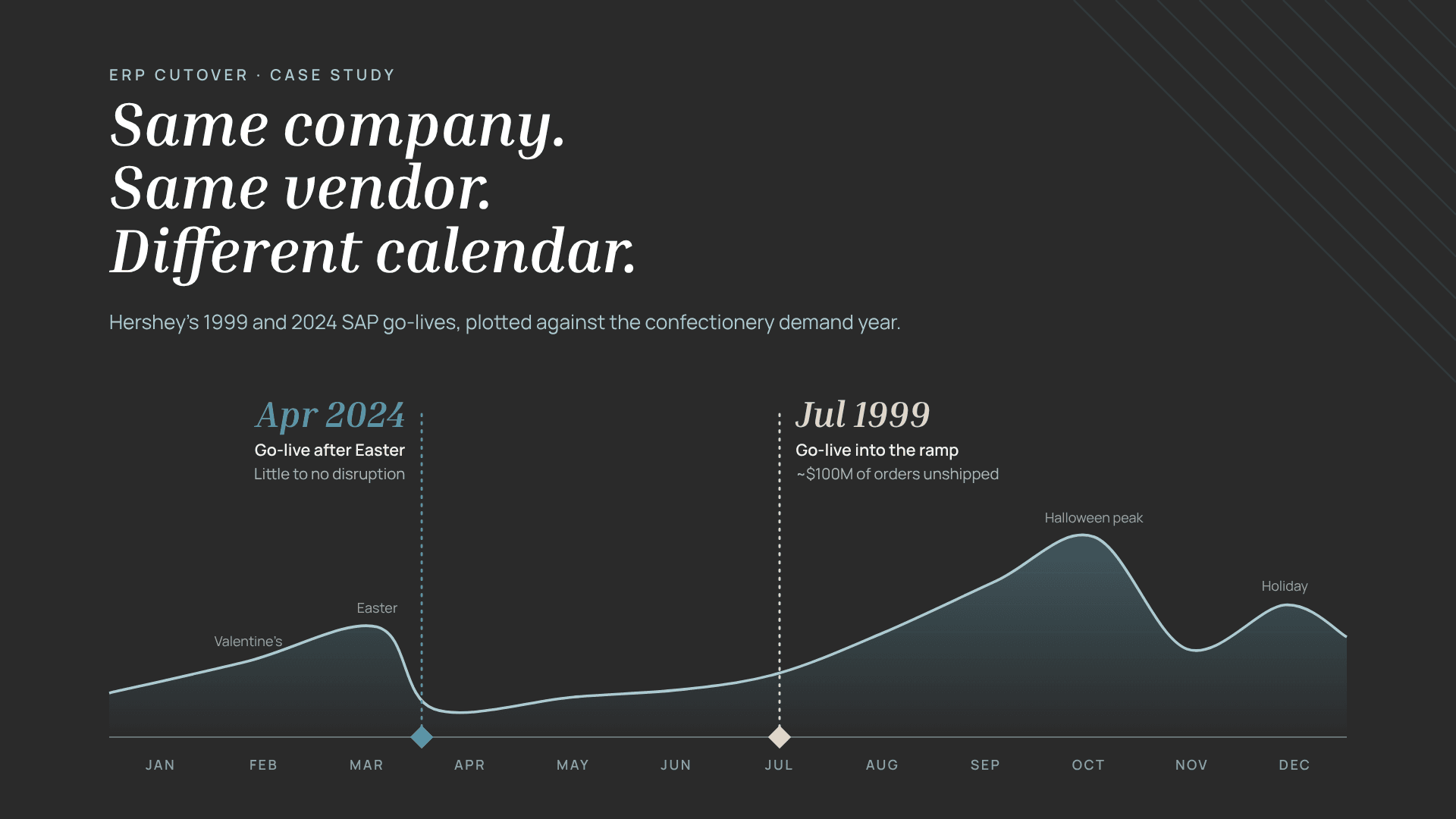
The Hershey Company has run that event twice on SAP. In July 1999, a $112 million stack from SAP, Siebel and Manugistics went live as Halloween orders were arriving; about $100 million of orders went unshipped and third-quarter profit fell 19%. In the first week of April 2024, Hershey moved its US, Canadian and select international markets onto SAP S/4HANA just after Easter, with retailer inventory built in advance, and reported little to no disruption on shelf. The difference between the two outcomes was planning for the operation, not the technology, and it is the most useful precedent CPG supply chain leaders have for putting AI into daily operating decisions.
1999: a big-bang go-live into the biggest selling window
Hershey's 1999 failure was a timing and scope failure: three enterprise systems were switched on together, weeks before the most concentrated demand window in confectionery.
The program, known internally as Enterprise 21, began in late 1996 on a $112 million budget. The stack combined SAP R/3 for finance, purchasing, materials management, warehousing, order processing and billing; Siebel for promotions management; and Manugistics for production forecasting and scheduling, according to Computerworld. It went live in July 1999.
By September, CEO Kenneth Wolfe told analysts the new order-taking and distribution system would keep roughly $100 million of Kisses and Jolly Ranchers from reaching retailers for Halloween, as CIO reported. The stock fell about 8%, and third-quarter profit dropped 19%. The damage carried into the holidays: fourth-quarter 1999 sales fell from $1.24 billion to $1.11 billion, profit fell from $110 million to $98 million, and Hershey had been forced onto a 12-day order-delivery cycle, Computerworld reported.
The detail that makes the case instructive is that Hershey had product. Inventory sat in warehouses while orders could not flow through the new integrated system to trucks. SAP maintained that R/3 itself was not at fault, and CIO's later assessment was that Hershey's rollout was fairly typical for an ERP program; its one real mistake was going live into peak season. Seasonal candy has a short value window. An order missed in October is not recovered in November, and the shelf space goes to a competitor.
2024: a cutover designed backward from the demand calendar
Hershey's 2024 S/4HANA cutover was planned backward from the retail shelf and the seasonal calendar, rather than forward from an IT timeline.
Three choices stand out in the company's own filings.
It phased the scope. Hershey moved its North America Salty Snacks business (SkinnyPop, Dot's Pretzels, Pirate's Booty) onto its new ERP first, in October 2023, and deliberately ran down inventory around that switch. Segment net sales fell 24.6% in Q4 2023 to $205.2 million. Sixteen points of that decline came from planned ERP-related inventory reductions; the rest reflected softer popcorn demand and reduced advertising and merchandising around the upgrade, per Nosh.
It chose the trough. The core cutover for the US, Canada and select international markets happened the week of April 1, 2024, immediately after Easter (March 31 that year) and roughly six months before Halloween orders peak, according to Hershey's Q1 2024 prepared remarks.
It buffered the shelf. Hershey worked with retailers to build stock ahead of the switch. Q1 2024 net sales rose 8.9% to $3.25 billion; about 7 points of that growth came from elevated pre-cutover inventory, with the underlying business growing closer to 2% (Hershey Q1 2024 results, SEC filing). Management said customers had inventory on hand and the market saw little to no disruption.
The bill arrived on schedule. Q2 2024 net sales fell 16.7%, including a roughly 9-point decline from planned inventory reductions tied to the implementation (Q2 2024 results, SEC filing). Because the swing was planned and disclosed in advance, investors could read it as the price of safety rather than a failure.
Same company, same vendor: the variable was operations planning
Putting the two go-lives side by side isolates the variable: the company, the category and the core vendor were constant, while the operational planning around the cutover was not.
Dimension | 1999 (SAP R/3, Siebel, Manugistics) | 2024 (SAP S/4HANA) |
|---|---|---|
Go-live timing | July, ahead of the Halloween peak | Week after Easter, about six months before Halloween |
Scope | Three systems switched on at once | Salty Snacks first (Oct 2023), core markets second (Apr 2024) |
Inventory | No pre-built buffer at retail | About 7 points of Q1 sales pre-shipped to retailers |
Market outcome | About $100M of orders unshipped | Little to no disruption reported |
Financial signal | Q3 profit down 19%, explained after the fact | Planned Q1 lift and Q2 dip, disclosed in advance |
Hershey's 1999 outcome is not an outlier. Gartner predicts that by 2027 more than 70% of recently implemented ERP initiatives will fail to fully meet their original business goals, and ties much of that to technology-centric programs that skip stakeholder alignment. Hershey's 2024 program ran the other way. Its decisive choices were about the calendar, the retailers and the inventory position, not configuration.
Today more than 95% of Hershey's global business runs on a single SAP instance.
The harder problem: decisions between the demand signal and the truck
With transactions consolidated, Hershey's margin exposure has shifted from the system of record to the speed and quality of daily operating decisions.
At CAGNY in February 2025, CFO Steve Voskuil described the next step as integrated demand planning, built with Kinaxis, intended to "tie the demand signal on one side to the supply chain response" (Steve Voskuil, SVP and CFO, The Hershey Company, as reported by Consumer Goods Technology).
Two conditions make that layer expensive to get wrong.
The first is input volatility. ICE New York cocoa futures traded between roughly $10,400 and $11,700 a tonne during January 2025 (ICCO January 2025 market review), weeks after a continuous-contract record near $12,931 in December 2024 (Barchart). Prices then slid through 2025, bottomed in March 2026, and at their peak since have more than doubled from that low (Barchart). Hershey's adjusted gross margin for Q4 2025 was 38.3%, down 650 basis points year over year (Zacks). It recovered to 42.2% for the first half of 2026, against 32.1% a year earlier, on pricing and productivity savings (Hershey Q2 2026 10-Q).
The second is demand that outruns the network. In Q2 2026, Hershey said strong Dot's Pretzels demand had strained salty-snack capacity, pushing it onto spot freight and higher logistics costs with limited throughput, and it trimmed its full-year gross-margin outlook (MarketBeat call summary).
That is the decision gap in plain terms. The ERP records the spot-freight invoice accurately. It does not decide, ahead of time, which plant should absorb a surge, which distribution center should be rebalanced, or when a contracted lane is still cheaper than the spot market.
What the 1999-vs-2024 lesson means for the AI layer
The AI layer will succeed or fail on the same variables Hershey's ERP did: when it goes live, which decisions it touches first, and how the operation is protected while it learns.
The pressure to move fast is real. Gartner predicts that by 2028, 15% of day-to-day supply chain decisions will be made autonomously by AI agents (Gartner). Gartner senior director analyst Jan Snoeckx has also cautioned that vendors promising end-to-end autonomous supply chain planning before 2027 are overstating near-term capability (IT-Online). Read together, those two statements describe the same discipline Hershey had to learn.
Choose the trough. An AI agent's first live decisions should not be Halloween replenishment. Start in a low-volume window and run the system in shadow mode against human planners until its recommendations hold up across a full demand cycle.
Buffer the shelf. In 2024 the buffer was physical inventory. For an AI layer, the buffer is decision guardrails: order-quantity and spend limits, approval gates for costly or hard-to-reverse actions such as spot-freight bookings, and a defined fallback to the human plan.
Phase the scope. Salty Snacks went first in 2023. The AI equivalent is one decision class in one category, such as freight mode selection for a single brand, proven before anything is extended enterprise-wide.
The real lesson
Hershey took 25 years to learn how to change systems without losing a Halloween. The lesson was never that SAP got better. It was that the operation had to be ready to absorb the change, on a calendar it chose, behind a buffer it built. CPG companies now adding AI on top of their ERP face the same test in a new form: not whether the model is good, but whether the business can absorb its first mistakes outside peak season.


