


Most companies are buying visibility to solve a tariff problem that is really a decision-speed problem.
Geopolitical and tariff risk mitigation is the set of supply chain capabilities — sourcing flexibility, scenario modeling, and decision automation — that lets a company change where and how it makes and moves goods faster than a disruption can erode its margins. For two decades, that capability was a tail-risk insurance policy most operators underfunded. In 2025 and 2026, it became the operating reality.
The instinct of most leaders has been to treat this as a cost problem: model the tariff, absorb or pass through the hit, move some inventory. That response is rational and incomplete. The companies pulling ahead are not the ones with the cleverest tariff arithmetic. They are the ones who have compressed the time between a policy shock and a committed sourcing decision from quarters to days. Technology is central to that compression — but only if it is pointed at the decision, not at the dashboard.
The shift is structural, not a passing storm
Tariff and geopolitical exposure is now a permanent design constraint on global supply chains, not a cyclical disruption to wait out. The numbers make this hard to dismiss. In McKinsey's Supply Chain Risk Pulse 2025, 82 percent of surveyed companies said new tariffs are affecting their supply chains, with 20 to 40 percent of supply chain activity impacted in some way. Geopolitics has overtaken cost as the dominant boardroom concern: in WTW's Global Supply Chain Risk Report 2025, 55 percent of respondents named geopolitical factors a top concern, up from 35 percent in 2023.
This is not a quarter to manage through. It is a new baseline. McKinsey found that 43 percent of respondents plan to shift more of their supply chain footprint to the United States over the next three years — a 25 percentage-point jump from the prior survey — and 38 percent plan to reduce their presence in China. Forty-five percent are increasing inventory buffers, and 39 percent are pursuing dual sourcing for components or raw materials. Footprint decisions of that magnitude do not get reversed when one administration changes.
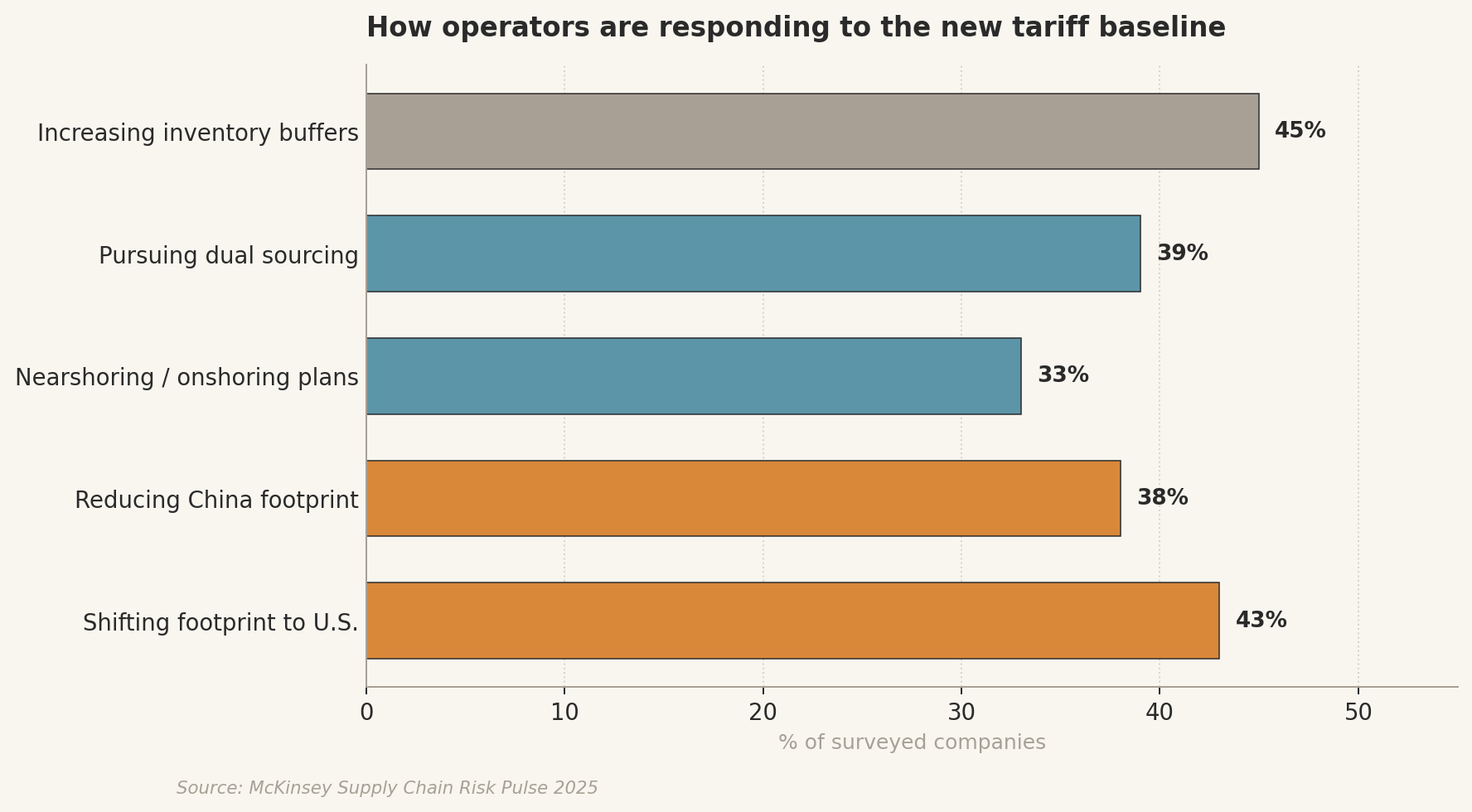
The pattern in the chart above is worth pausing on. The two responses with the highest adoption — buffering inventory and dual sourcing — are tactical hedges that buy time. The structural moves — footprint shifts and nearshoring — are the ones that demand a decision-architecture that can act before the next policy change rewrites the math.
Visibility is not the bottleneck — most leaders are solving the wrong problem
The constraint slowing tariff response is rarely a lack of data; it is the time it takes to turn data into an authorized decision. The market has spent a decade selling supply chain "visibility," and most large operators now have more dashboards than they can read. Yet according to PwC's 2025 Digital Trends in Operations Survey, 87 percent of respondents say geopolitical risk is pushing them toward more flexible operations — flexibility their current tooling was never built to deliver. Seeing a tariff land is not the same as being able to act on it.
The difference between observation tools and decision tools shows up clearly when the two are placed side by side:
| Capability | Observation tool | Decision tool |
|---|---|---|
| Primary output | A view of what's happening | A committed, authorized action |
| Time horizon | Real-time monitoring | Pre-authorized response inside a defined window |
| Authority embedded? | No — alert routes to a human | Yes — guardrails, thresholds, approvers baked in |
| Useful during a shock | Tells you the building is on fire faster | Moves the furniture |
| Typical investment label | "End-to-end visibility" | "Scenario modeling," "agentic execution," "playbooks" |
The technologies that genuinely move the needle share one trait: they shorten the path from signal to action. Scenario modeling and digital twins let a planning team test "what happens if this lane gets a 25 percent duty" against thousands of SKU-supplier-route combinations in an afternoon rather than a quarter. AI-driven forecasting, which McKinsey estimates can reduce supply chain errors by 20 to 50 percent, matters less for its accuracy than for the confidence it gives a leader to commit to a sourcing shift before the disruption fully arrives.
"Predictive tools tell you what's coming. The advantage goes to whoever decides what to do about it first."
In our work with enterprise CPG operators, the same pattern recurs: the data to make the call already exists somewhere in the organization. What is missing is a system that assembles it into a decision-ready form and routes it to someone with the authority to act before the window closes. That is an operating-model problem wearing a technology costume.
What the industry isn't saying out loud
Most "AI for supply chain" investment is being spent on watching disruptions rather than responding to them. Demand forecasting, inventory optimization, and supply planning are the most common deployments, and they are valuable — but they are observation tools. They tell you the building is on fire faster than before. They do not move the furniture.
That is starting to change, and the spend curve shows where the market is heading.
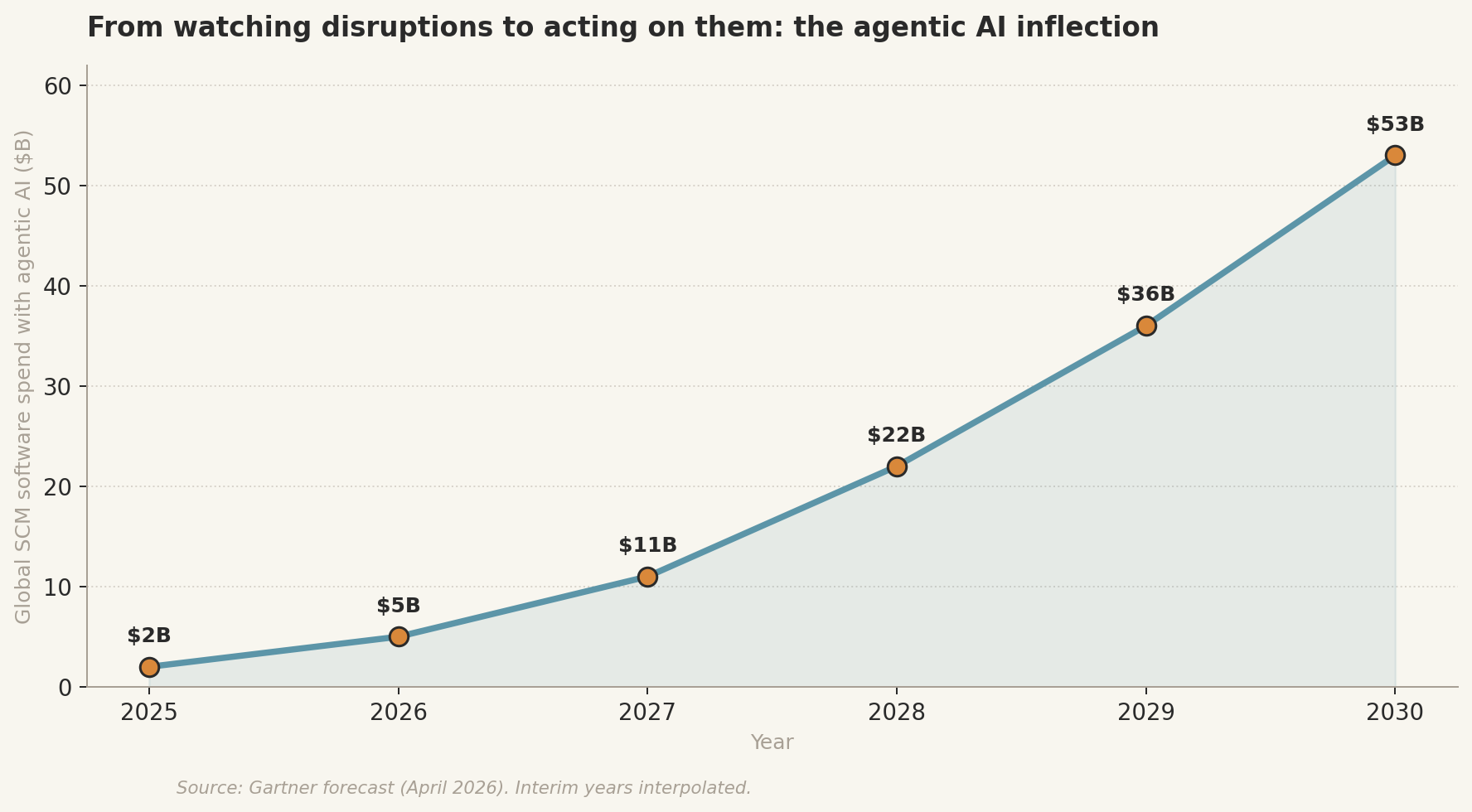
Gartner forecasts that supply chain management software with agentic AI will grow from less than $2 billion in 2025 to $53 billion by 2030. The same firm projects that 60 percent of supply chain disruptions will be resolved without human intervention by 2031. The frontier is no longer monitoring; it is execution under pre-agreed guardrails.
The gap shows up in follow-through. Despite years of investment in end-to-end visibility, only a small fraction of organizations report having actually achieved it. The reason is not technical. Visibility programs deliver a screen; tariff resilience requires a decision — and decisions need pre-agreed authority, thresholds, and playbooks that most organizations have never written down. When a duty lands overnight, the constraint is not "what is happening." It is "who is allowed to reroute this, by how much, without a steering committee."
Autonomous and agentic systems are beginning to close that loop — not by removing humans, but by executing pre-authorized responses within defined guardrails so the human decision is made once, in calm conditions, rather than re-litigated during every shock. We've written separately on how agentic AI is reshaping supply chain operations, and the same logic applies here: the shift from monitoring to acting is the actual frontier, and it is far less crowded than the visibility market would suggest.
The implication
Geopolitical and tariff risk is not going to be engineered away by a better model or a single platform. The exposure is structural, and the companies that fare best will be the ones that accept it as a design constraint and rebuild their decision architecture around it — sourcing optionality they can activate quickly, scenario tooling they actually run, and clear authority for who acts when the signal arrives.
Heizen is an AI-native software delivery company that builds supply chain systems for enterprise CPG and manufacturing companies. The operators we see winning the tariff era are not the ones with the most dashboards. They are the ones who decided, in advance, how they would move — and built the systems to move that fast.


