To compare supplier quotations automatically, you turn every quote into the same shape before you score it. An AI agent reads each quote from email, PDF or spreadsheet, converts it to one currency, one unit and one landed cost that includes freight, and then ranks suppliers with weighted scoring on price, lead time, payment terms and past performance. Gaps are flagged, and a buyer approves the final choice.
This guide walks through one example with five bids, step by step, so you can see exactly where the time goes and where the mistakes hide.
Why is comparing supplier quotations so hard?
Picture a buyer with five quotes for the same part. Each supplier answered the same RFQ, yet no two quotes look alike:
· Different currencies: one supplier quotes in US dollars, the rest in rupees.
· Different units: per piece, per box of 100, per pack of 12.
· Different freight terms: some include delivery, some quote ex-works and leave freight to you.
· Different payment terms: 30 days, 60 days or full payment in advance.
· Missing details: no freight figure, no validity date, or less than the full quantity.
The quotes also arrive in different places: email bodies, PDF attachments, Excel sheets and supplier portals. Someone has to retype all of it into one sheet, often called a comparative statement, before the real comparison even starts.
Bad data makes this worse. Kaitlynn Sommers, Senior Director Analyst at Gartner, warned in July 2025 that “fragmented and low-quality data across procurement systems can hinder accurate outputs” from generative AI. In other words, an AI tool is only as good as the comparison rules and data underneath it.
What do the 5 sample supplier quotes look like?
Here is our worked example. A plant in Pune needs 5,000 ball bearings (6204-2RS) delivered within three weeks. Five suppliers reply. All names and numbers are test data, made up for this guide.
Table 1. Five supplier quotes for the same RFQ, exactly as received (test data).
How do you normalize supplier quotes before comparing them?
Normalizing means putting every quote on the same basis: the same currency, the same unit and the same delivery point. It takes three steps.
Step 1: Convert every price to one currency
· Pick one currency, usually the one you pay in. Here that is the rupee.
· Use one agreed exchange rate for all quotes, and record the date. We assume ₹88 per US dollar.
· Supplier C: US$0.40 × 88 = ₹35.20 per piece.
Step 2: Bring every price to the same unit
· Pick the unit you order in. Here that is one piece.
· Supplier B: ₹3,450 ÷ 100 = ₹34.50 per piece.
· Supplier E: ₹420 ÷ 12 = ₹35.00 per piece.
Step 3: Add freight to get the landed cost
Freight terms decide who pays to move the goods. The International Chamber of Commerce’s Incoterms® 2020 rules set out how cost, risk and obligations are split between buyer and seller, so check the term on every quote.
· Delivered or DDP quotes (A, C, E) already include freight. Nothing to add.
· Supplier B quotes ex-works plus ₹9,000 freight: ₹9,000 ÷ 5,000 = ₹1.80, so ₹36.30 per piece.
· Supplier D quotes ex-works with no freight at all. Using the last shipment on the same route, we estimate ₹2.40 per piece, so ₹35.40 per piece, and we flag it as an estimate.
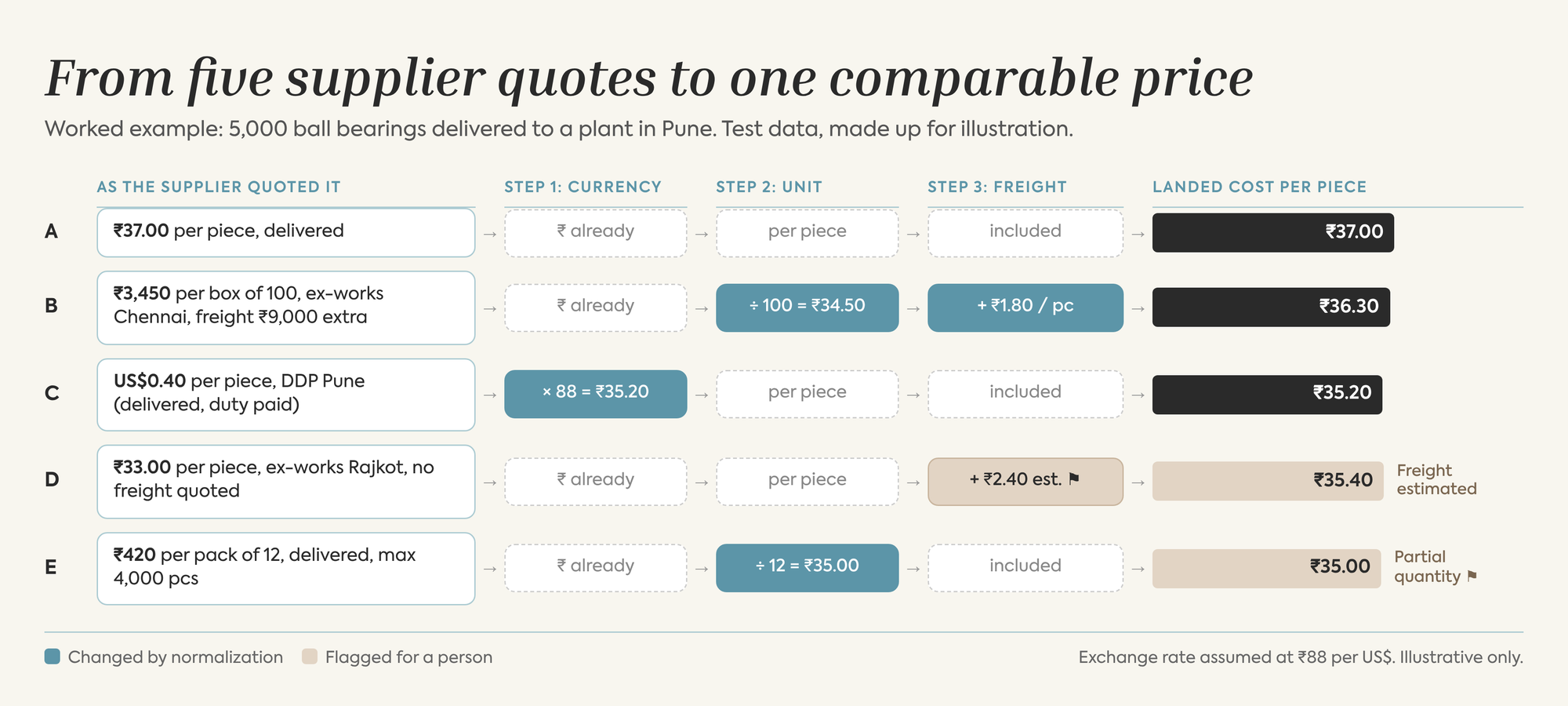
How five differently priced quotes become one comparable landed cost per piece.
Table 2. The same quotes after normalization, sorted by landed cost (test data).
The ₹33 quote is now third. The cheapest landed cost belongs to Supplier E, but E can only supply 4,000 of the 5,000 pieces. This is why normalization has to come before any ranking. The same clean-up matters when your supplier data is messy.
How does weighted scoring pick the best supplier?
Price is not the only thing that matters. Weighted scoring gives each criterion a share of 100 points, so you can compare suppliers on everything you care about at once.
Agree the weights before you open the quotes
For this order, the plant needs the bearings soon, so speed matters. The team agrees these weights up front, for example:
· Landed price: 50%
· Lead time: 20%
· Payment terms: 15%
· Supplier performance (quality and on-time delivery history): 15%
Setting weights first stops anyone from adjusting them later to favor a supplier they already like. Performance scores usually come from a supplier evaluation scorecard.
Turn each criterion into a score out of 100
· Price: lowest landed cost ÷ this supplier’s landed cost × 100.
· Lead time: shortest lead time ÷ this supplier’s lead time × 100.
· Payment terms: this supplier’s credit days ÷ the longest credit days × 100. Advance payment scores 0.
· Performance: taken straight from the scorecard. Supplier D is new, so it gets a cautious default of 70.
The result
Table 3. Weighted scores out of 100 (test data).
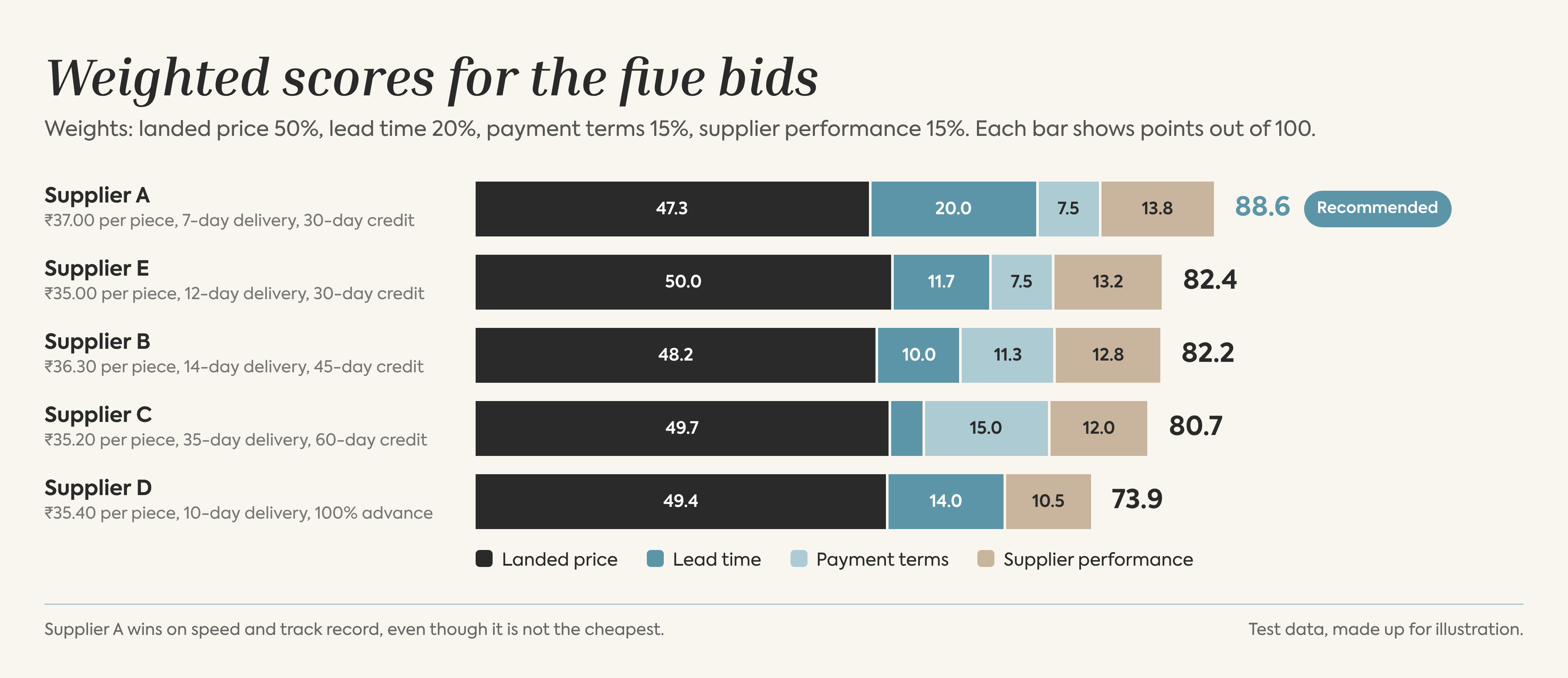
Supplier A comes out on top because it delivers fastest and has the strongest track record.
Supplier A wins, even though it is the most expensive. It costs ₹10,000 more than Supplier E on this order, but it delivers in 7 days and has the best track record.
What happens if you change the weights?
· With price at 60% and lead time at 10%, Supplier C edges ahead with 88.7 against A’s 88.1.
· That is not a flaw. It shows that the weights are a business decision, not a maths problem.
· Write down why you chose them, so the award can be explained later.
Which exceptions need a person before sign-off?
Automatic quote comparison should not decide everything. In our example, four issues need a buyer’s judgement:
· Supplier D: freight missing and no validity date. The agent asks the supplier to confirm both.
· Supplier E: partial quantity. E can only supply 4,000 pieces. One option is a split award: 4,000 from E and 1,000 from A, for ₹1,77,000 in total instead of ₹1,85,000.
· Supplier C: currency risk. A 35-day lead time in US dollars means the rupee cost can move before you pay.
· Supplier A: not the lowest price. Many companies require a written reason when the award does not go to the lowest bidder.
What the approver sees
Instead of five PDFs and a spreadsheet, the approver gets one decision card:
· The recommended supplier, or the split award, with the total value.
· The normalized comparison table and the weights used.
· Every flag, and how it was resolved.
· A box for the reason, if the award does not go to the lowest landed cost.
The approver accepts, changes or rejects the recommendation, and the decision is logged.
What does automatic quote comparison look like in practice?
Two Heizen projects use the same ideas in this guide:
· Godrej Consumer Products (GCPL). Supplier quotes used to arrive by email and were re-entered by hand. Heizen built an RFQ workflow where AI extracts each quote, sorts it into triage queues, ranks suppliers on landed cost, and records a justification whenever the award does not go to the lowest bidder.
· Al Bahja Group (Oman). Heizen is building a shared procurement platform where offers are compared on price, delivery period, payment terms and certifications. The system recommends a supplier, the buyer can choose another, and the Purchase Head approves before any PO is released. It is built and in testing ahead of user acceptance.
Which tool should you use to compare supplier quotations?
The right tool depends mostly on how many quotes you handle and where they arrive.
Table 4. Ways to compare supplier quotations, with trade-offs.
On the ERP point, SAP’s own S/4HANA training says its Compare Supplier Quotations app shows up to three quotations side by side, and that “other factors, such as supplier evaluation score, are not included” in its best-price calculation. That works well once quotes are in the system. The hard part is usually getting them there.
Frequently asked questions (FAQs)
How do you compare supplier quotations automatically?
An AI agent reads each quote, converts it to one currency, unit and landed cost, scores it against agreed weights, and flags gaps such as missing freight. A buyer reviews the ranking and approves the award.
What is the best way to compare quotes from different suppliers fairly?
Normalize every quote to the same basis first, then use weighted scoring with weights agreed before the quotes are opened. Record the reason for any award that does not go to the lowest landed cost.
What criteria should a supplier quote comparison include?
Most teams use landed price, lead time, payment terms and supplier performance. Some add quality certifications, warranty or minimum order quantity, depending on the category.
Can AI choose the supplier on its own?
It shouldn’t. AI is good at reading, normalizing and ranking quotes, but the award should stay with a person, especially when the data is incomplete or the recommended supplier is not the cheapest.
Conclusion
The cheapest quote on paper is rarely the cheapest order. Comparing supplier quotations fairly means normalizing currency, unit and freight first, then scoring on what actually matters to the business. AI can do the reading, converting and ranking in minutes. Buyers keep the judgement calls and the final sign-off.
Sources
· Gartner, “Gartner Says Generative AI for Procurement Has Entered the Trough of Disillusionment” (press release, 30 Jul 2025): https://www.gartner.com/en/newsroom/press-releases/2025-07-30-gartner-says-generative-ai-for-procurement-has-entered-the-trough-of-disillusionment
· International Chamber of Commerce, “Incoterms® 2020”: https://iccwbo.org/business-solutions/incoterms-rules/incoterms-2020/
· SAP Learning, “Working with Quotations” (Sourcing in SAP S/4HANA): https://learning.sap.com/courses/sourcing-in-sap-s4hana/working-with-quotations
· Heizen case studies: https://heizen.work/case-studies