


AI demand forecasting is a class of supply chain planning in which machine-learning systems replace static, history-based statistical models with models that ingest hundreds of internal and external signals to predict demand. For CPG and FMCG enterprises, the practical result is a 20–50% reduction in forecast error on priority SKUs — which flows directly into lower inventory, fewer stockouts, and higher service levels.
That matters now because the old approach is no longer holding. Legacy forecasting broke during COVID and never fully recovered, and most consumer goods planning stacks are still running on methods designed for a more stable world. The question for supply chain leaders isn't whether to move to AI forecasting — it's how to deploy it without launching another multi-year, rip-and-replace implementation. Gartner predicts that 70% of large organizations will adopt AI-based supply chain forecasting by 2030, which gives planning teams roughly a three-year window before the gap becomes hard to close.
Why classical forecasting stopped working
Classical forecasting fails in modern CPG because it assumes the future looks like a weighted version of the past — and that assumption no longer describes how demand behaves. For three decades, consumer goods supply chains ran on ARIMA, exponential smoothing, and Holt-Winters. Those methods held up reasonably well in stable demand environments.
They stopped holding around 2020. Consumer behavior shifts faster now. Channel mix — retail versus e-commerce versus quick commerce — distorts historical baselines. Promotional intensity has climbed, and new product introductions arrive with little or no history to train on. Gartner's benchmark for food and beverage operators puts the median forecast error at roughly 25% (upper quartile at 20%) — and on new SKUs the picture is worse, with internal benchmarking across global CPGs consistently showing accuracy below 40% in the first 12–18 months post-launch. For over a year after launch, the forecast is wrong more often than it is right.
The damage compounds because both sides of the inventory equation degrade at the same time. When forecasts are wrong, buffer stock climbs to protect service levels — eating working capital and generating write-downs. Meanwhile, stockouts persist anyway, because the inventory ends up in the wrong distribution centers and the wrong SKUs. The planner is simultaneously over-invested and under-served.
| What classical models assume | What CPG demand actually does (2020–2026) |
|---|---|
| The past repeats with seasonal patterns | Channel mix and consumer behaviour reset every 12–18 months |
| Promotions are an additive lift on a baseline | Promotional intensity is now the baseline |
| New SKUs inherit a parent profile | New SKUs have no useful history for 12+ months |
| Demand is the right unit of analysis | The right unit is demand × channel × week × location |
What AI demand forecasting does differently
The difference between AI forecasting and classical forecasting isn't more sophisticated math — it's a fundamentally different input set and objective function. A machine-learning system blends structured internal data (orders, shipments, promotions, inventory positions) with a long tail of external signals: POS scan data, weather forecasts, macroeconomic indicators, search trends, retailer planogram changes, and competitor pricing.
Modern models — gradient-boosted trees like LightGBM and XGBoost, and neural approaches like Temporal Fusion Transformers and N-BEATS — handle thousands of features and capture nonlinear interactions that linear statistical methods simply cannot represent.
Two capability shifts matter most for consumer goods. The first is demand sensing: updating short-term forecasts daily, sometimes hourly, based on real-world signals rather than weekly refresh cycles. For fresh, frozen, and promotional categories, this is the difference between making a retailer's weekend replenishment window and missing it. The second is probabilistic forecasting: instead of a single point estimate, the model outputs a full distribution. Planners and optimisation engines can then target a specific service level at a specific cost, rather than padding safety stock uniformly across tens of thousands of SKU-location combinations.
What the accuracy gains look like in practice
The accuracy gains from AI forecasting are now visible in public results from the largest consumer goods operators, not just in vendor case studies. The gap shows up most sharply on the SKUs that were hardest for legacy models — new launches, promoted products, fresh categories, and long-tail items.
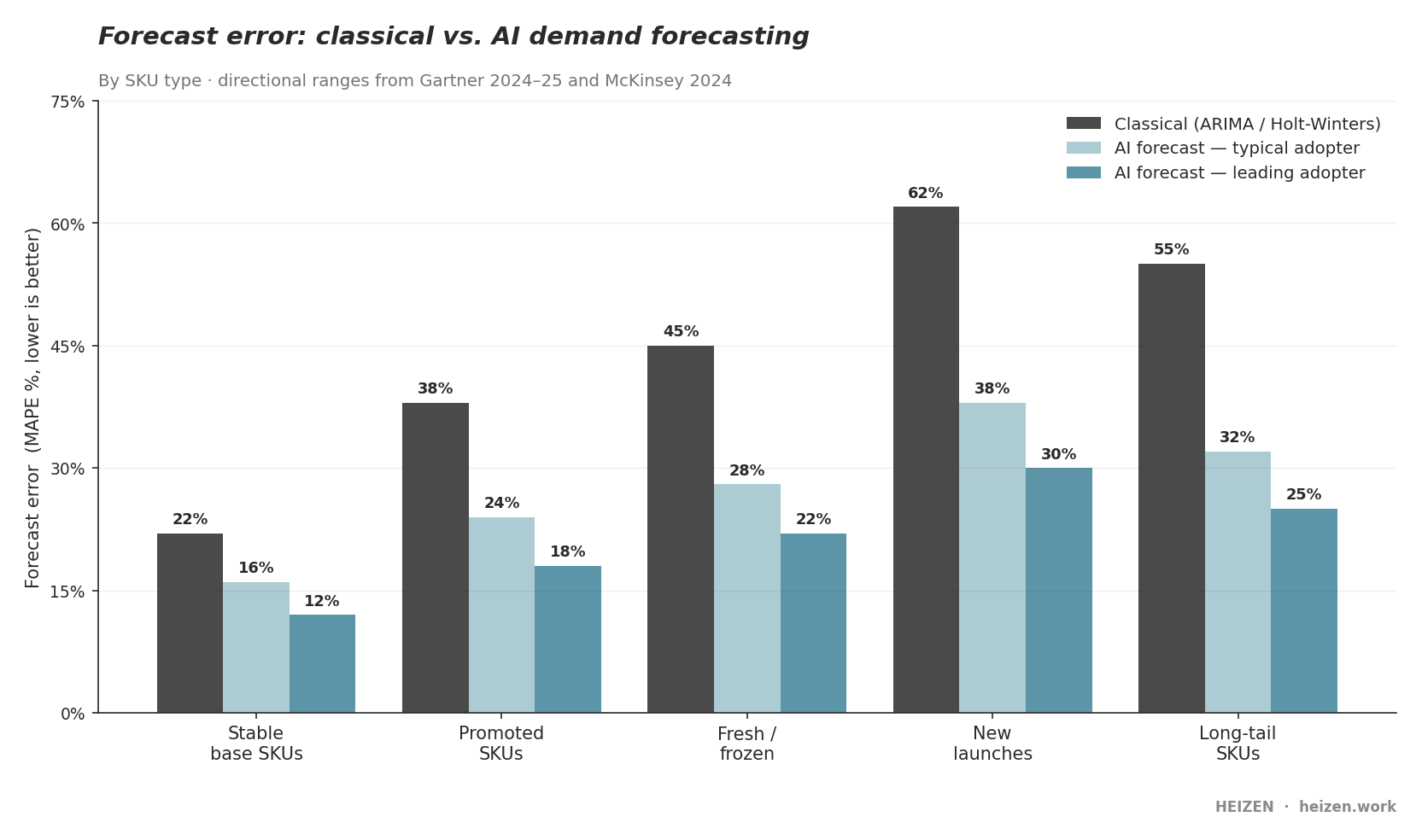
Unilever has spoken publicly about 30%+ improvements in forecast accuracy across key categories after rolling out its AI-driven planning platform, translating into measurable reductions in write-offs and stockouts. Nestlé has reported significant accuracy improvements on fresh and frozen categories, where demand-sensing windows matter most. Procter & Gamble's digital supply chain program has cited accuracy and responsiveness gains from AI-led planning, particularly on new product launches where history is thin.
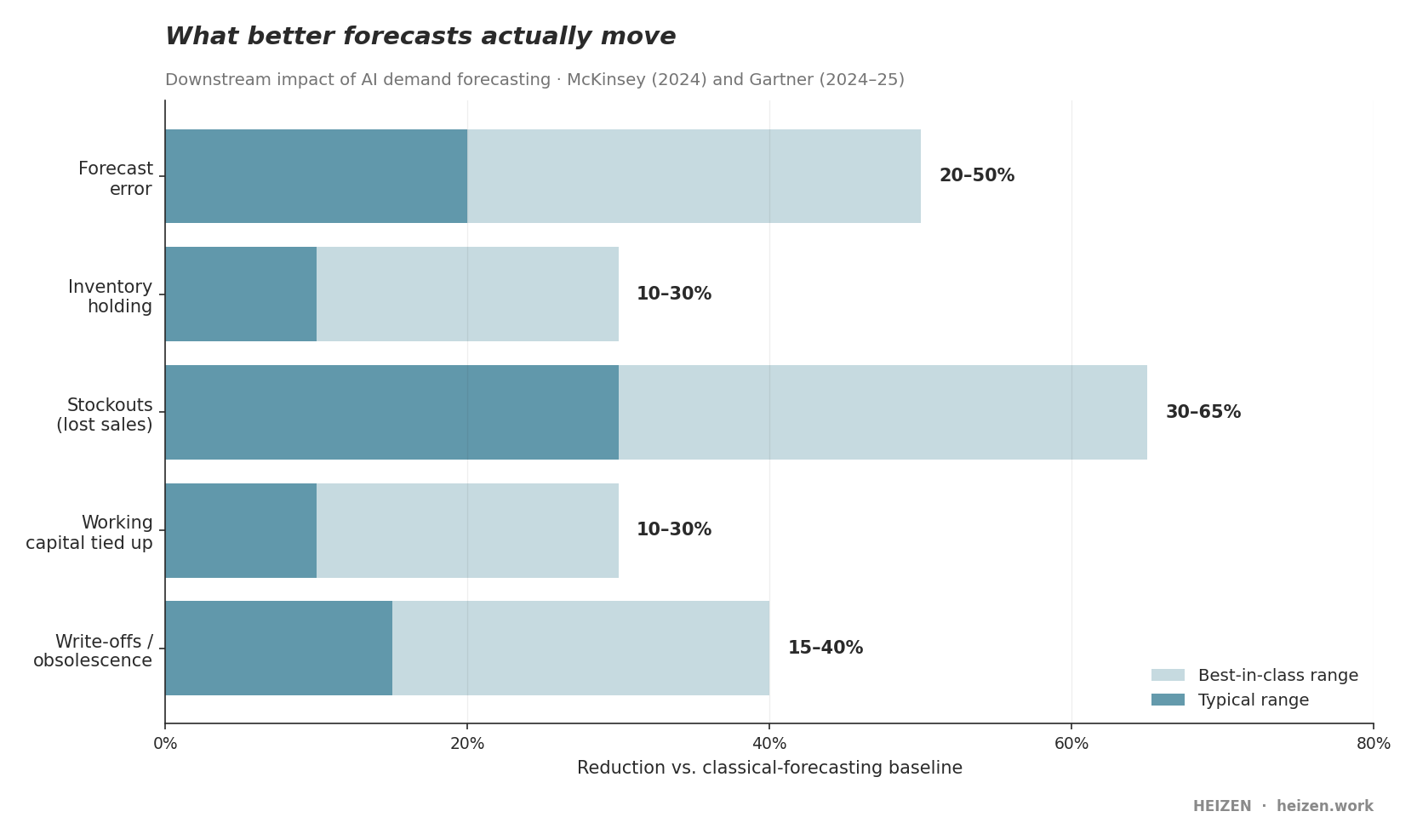
Independent research converges on similar numbers. Gartner's 2024 research suggests leading adopters are seeing a 20–50% reduction in forecast error on priority SKUs, with associated 10–15% inventory reductions at comparable or higher service levels. McKinsey's distribution-operations work puts the downstream impact even higher in best-in-class implementations: inventory reductions of 20–30%, lost sales from stockouts down by up to 65%, logistics costs down 5–20%.
| Metric | Typical AI uplift | Best-in-class | Source |
|---|---|---|---|
| Forecast error on priority SKUs | 20–30% reduction | up to 50% | Gartner 2024–25; McKinsey 2024 |
| Inventory holding | 10–20% reduction | 20–30% | McKinsey 2024 |
| Stockouts / lost sales | 30–40% reduction | up to 65% | McKinsey 2024 |
| Logistics cost | 5–10% reduction | 5–20% | McKinsey 2024 |
| Forecast accuracy uplift, CPG | 20–40% | up to 65% | Gartner; BCG |
Why most AI forecasting programs still stall
Most enterprise forecasting programs fail not because the models don't work, but because of the gap between a better number in a notebook and a forecast the S&OP process actually trusts enough to act on. Three failure modes show up repeatedly.
The first is data plumbing eating the budget. POS data, weather feeds, and macro signals live in different systems with different cadences and identifiers. Without an integration layer that reconciles them cleanly, the model starves. The second is the planner workflow never getting redesigned. An AI forecast dropped into a twenty-year-old planning process gets overridden the moment it disagrees with the planner's gut — and if the planner can't see why the model made a call, override rates stay high and the accuracy gains evaporate. The third is selling the project as a platform rather than an outcome: two-year timelines and seat-based pricing don't match how supply chains actually change. The model needs to start earning its keep in weeks, not quarters.
Heizen is an AI-native software delivery company that builds custom supply chain systems for enterprise CPG and manufacturing companies. In our work with enterprise CPG operators, the same lesson recurs: the model is rarely the bottleneck. The integration layer, the planner-facing explainability, and the workflow redesign are what determine whether the accuracy gain survives contact with the S&OP cadence.
"The model is rarely the bottleneck — the workflow around it is." — Nijansh Verma, Co-Founder at Heizen
The real decision in front of supply chain leaders
The choice is no longer classical versus AI forecasting — that debate is settled by the numbers. The real decision is structural: deploy AI forecasting as a focused, outcome-tied program that ships a production-grade forecast on one category in 8–12 weeks, or risk another multi-year platform rollout that's obsolete by the time it goes live. The companies pulling ahead are choosing the former — narrow scope, fast proof, then scale in waves. Gartner's latest forecast puts agentic-AI supply chain software spend at $53B by 2030, and most of that capex will move toward operators who can already prove a 90-day forecast win.
The forecast was never the point. The decision the forecast enables — how much inventory to hold, where to hold it, and which service level to defend — is. Classical models lost the ability to inform that decision somewhere around 2020. The replacement is already in production at the operators willing to redesign the workflow around it.


