


A sequenced operating model for moving from copilot to autonomous execution — without losing control of the decisions that matter.
Agentic AI in supply chain planning is a class of artificial intelligence systems that autonomously monitor operational signals, reason through multi-step decision logic, and execute supply chain actions — replenishment orders, inventory transfers, reroutes — within predefined business guardrails, without requiring a human prompt for each decision.
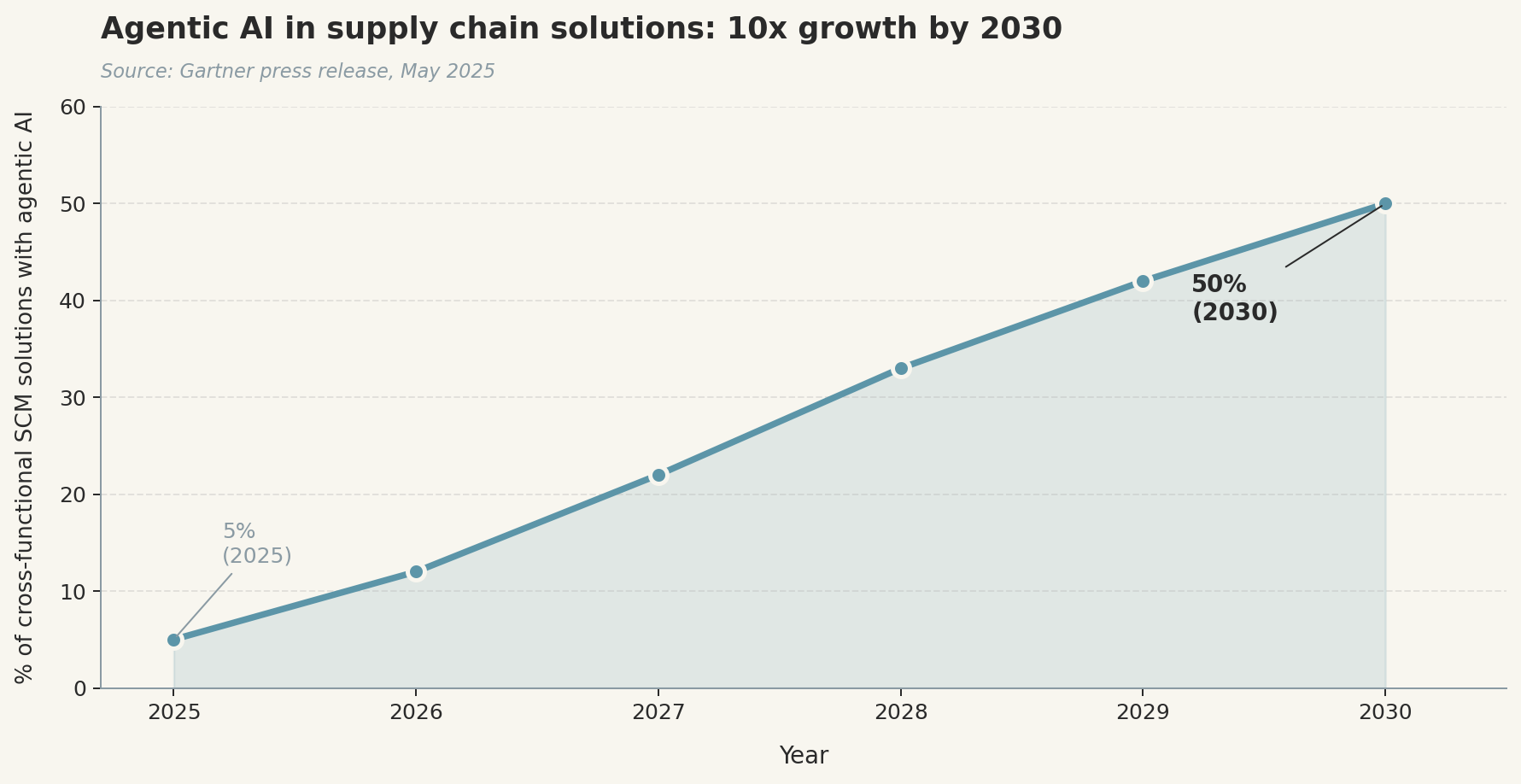
For CPG and manufacturing operations leaders, the question is no longer whether agentic AI belongs in the planning stack. Gartner projects that by 2030, 50% of cross-functional supply chain management solutions will use intelligent agents to autonomously execute decisions, up from roughly 5% in 2025. The decision now is how to sequence the transition: which decision classes to automate first, what authority model agents operate within, and how the planner role evolves as routine execution moves to software. The rest of this piece lays out a five-stage maturity model, the highest-fit early use cases, and the governance design that separates safe deployments from expensive remediations.
The Five Stages of Agentic Supply Chain Autonomy
Agentic supply chain autonomy progresses through five distinct stages — from human-only planning to fully autonomous network execution. The most common failure mode in enterprise CPG deployments is treating the move as a binary jump from copilot to autonomy, rather than a sequenced progression with explicit milestones.
The five stages, in order of increasing decision authority delegated to software:
| Stage | Description | Decision authority | Planner role |
|---|---|---|---|
| 0 — Manual | Planners ingest data, build forecasts, execute orders | None | Full execution |
| 1 — Advisory AI | AI forecasts and recommends; human decides and executes | None — recommends only | Decision + execution |
| 2 — Copilot | AI drafts decisions and surfaces options; human approves | None — drafts only | Approval + execution |
| 3 — Bounded agentic | AI executes routine decisions within guardrails; humans handle exceptions | Within defined bounds | Exception management + governance |
| 4 — Autonomous network | AI executes across the network; humans set policy and calibrate | Network-wide within policy | Policy design + audit |
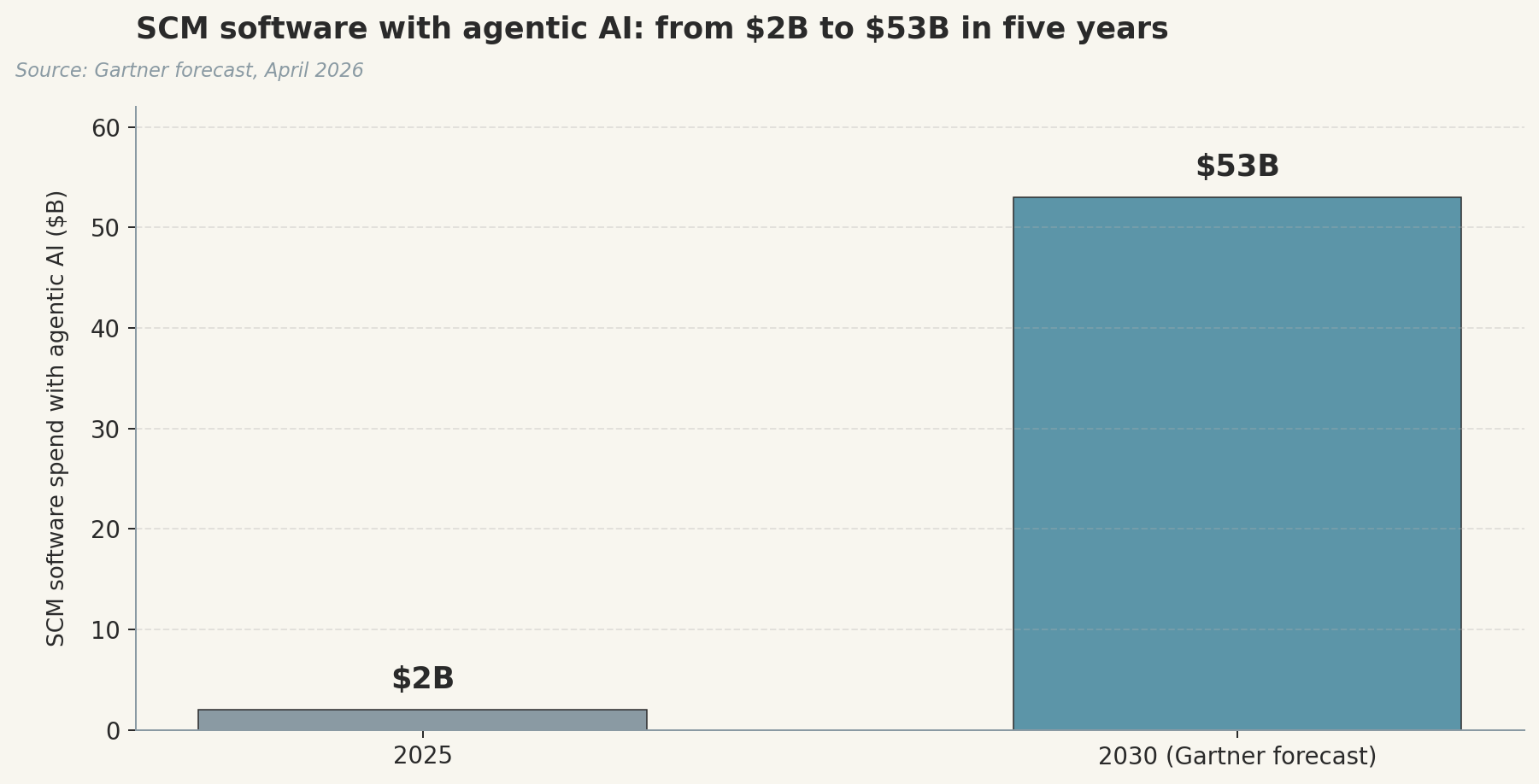
Most enterprise CPG operators today sit at Stage 1 or 2. The leading edge is moving to Stage 3 on specific decision classes — not Stage 4 across the network. Gartner forecasts the SCM software market with agentic capabilities will reach $53 billion by 2030, up from under $2 billion in 2025, signalling category-defining demand for tooling that supports the Stage 2-to-Stage-3 transition.
The mistake operators make is buying Stage 4 marketing while the underlying authority model, data plumbing, and exception workflows are not yet ready for Stage 3 on a single decision domain. The correct framing: each stage requires a different governance design, and the jump from Stage 2 to Stage 3 is the largest one.
Where to Deploy First: Use Case Selection
The decision classes that justify Stage 3 deployment share three traits: high decision volume, low individual exception risk, and well-defined success criteria. Three domains consistently meet all three for CPG and manufacturing operators.
Autonomous replenishment. Agents ingest point-of-sale data, inventory positions, and supplier lead times continuously, then execute reorder and rebalance decisions within parameters the business sets — service-level targets, cost ceilings, supplier preference rules. According to analysis aggregated by Supply Chain Management Review, AI-driven forecasting and replenishment cuts supply chain errors by 20–50% and reduces lost sales from stockouts by up to 65%. Most operators describe a 30–50% reduction in planner workload on the decision classes the agent takes over.
Disruption response. When a port closure or supplier failure hits, the effective response window is measured in hours, not the days a traditional S&OP cycle takes. Agents that monitor weather, shipping, and geopolitical signals can detect the event, assess downstream impact against ATP and logistics cost, and begin rerouting before a planner has opened the alert. Gartner predicts that by 2031, 60% of supply chain disruptions will be resolved without human intervention — a figure that would have read as speculative two years ago.
Demand signal integration. Agents ingest POS, promotional calendars, regional economic indicators, and weather patterns continuously, updating forecasts in real time rather than weekly cycles. The practical consequence is a plan that reflects today's reality, not last week's data.
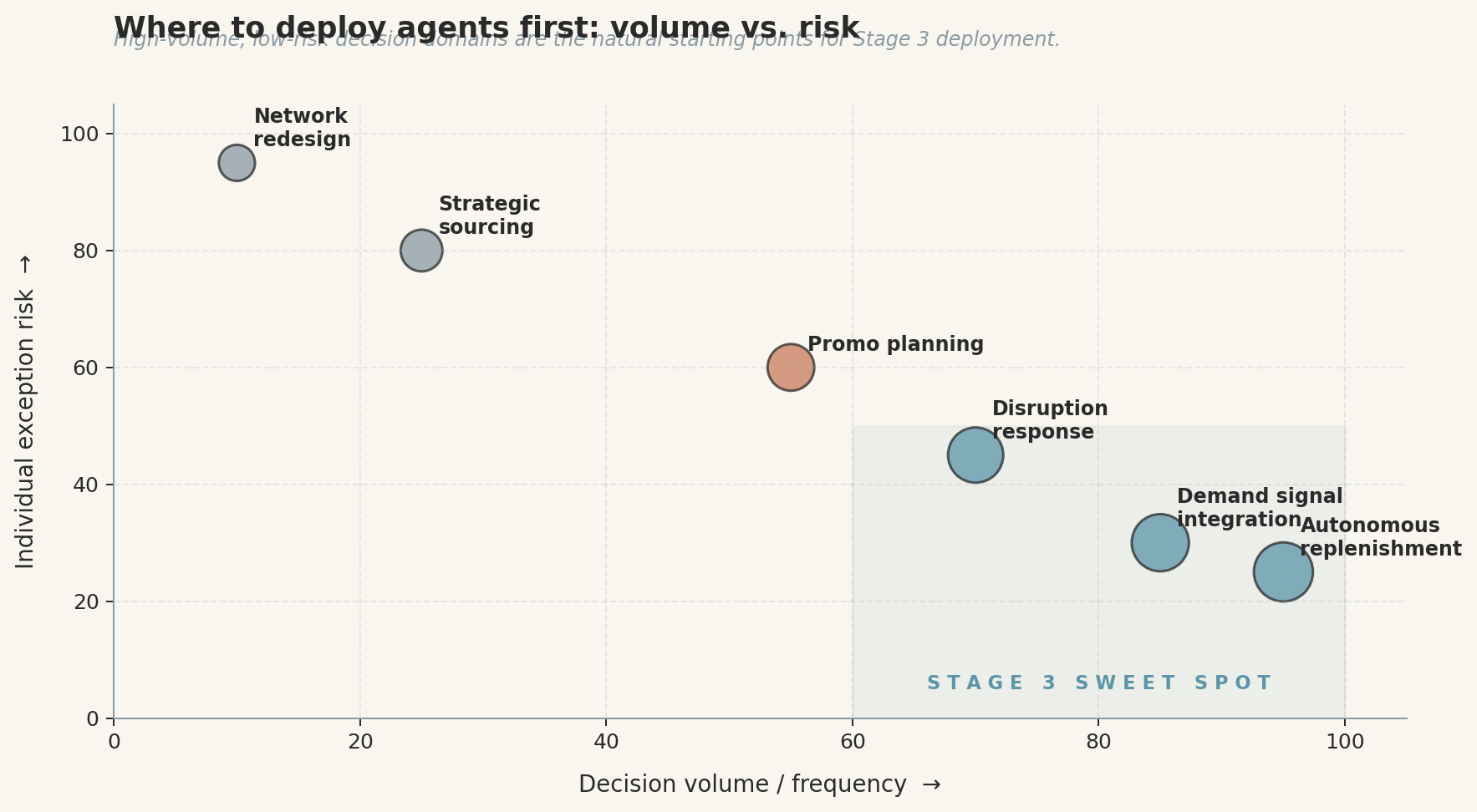
A useful filter for sequencing: rank candidate decisions by volume × time saved per decision × exception risk. The top three on that list, almost always, are where Stage 3 should start.
"Predictive tools tell you what's coming. Agents decide what to do about it."
Governance: Designing the Authority Model
The governance question is not how much the AI can do — it is at what threshold a decision requires human approval, and how that threshold is reviewed as the agent's track record builds. A well-designed agentic system answers four questions before going live.
| Component | What it defines | Example |
|---|---|---|
| Authority bounds | What the agent may do unilaterally | Spend ≤ $50K, A-class SKUs, EMEA only |
| Exception thresholds | What triggers human escalation | Forecast deviation >15%, new supplier, conflicting signals |
| Audit trail | What is logged for every decision | Inputs seen, options considered, choice, execution timestamp |
| Calibration cadence | How often the model is reviewed | Weekly outcomes review, monthly bound adjustment |
Authority bounds are usually expressed as combinations of spend ceiling, geographic scope, supplier tier, and SKU class. An agent authorised to transfer up to $50,000 of A-class SKUs within EMEA is governable. One with "execute replenishment" as its authority statement is not.
Gartner has explicitly warned of "agent washing" in the supply chain planning market — vendors overstating end-to-end autonomy capabilities — and recommends focusing early efforts on well-defined, high-volume planning activities where the cost of error is low. That is the right read of the current state.
The downstream effect on the planning team is real. In a February 2026 Gartner survey, 55% of supply chain leaders said they expect agentic AI to reduce entry-level hiring needs. The change is more accurately a shift in composition than a headcount cut: execution-focused roles compress; exception management, system governance, and authority-model calibration become the high-value work.
How to Sequence the Transition
Heizen is an AI-native software delivery company that builds supply chain systems for enterprise CPG and manufacturing companies. The pattern we see consistently in production deployments: the organizations making the fastest progress treat agentic AI as a decision design problem before a technology problem. The agent platform matters less than the authority model it is given to operate within.
The first 90 days of a serious agentic programme is not vendor selection. It is the scoping exercise — three to five decision classes that account for the majority of routine planner workload, evaluated on volume, time saved, and exception risk. Everything else follows from that clarity.
The shift from advisor to actor is underway. The operators who sequence it intelligently — by stage, by use case, by governance design — will compound the gains. The ones who buy Stage 4 marketing for a Stage 1 organization will spend the next two years in remediation.


