


How CPG and manufacturing leaders are turning resilience from a procurement exercise into a software problem — and what the four-layer stack actually looks like in production.
The geopolitical resilience stack is a four-layer technology architecture — multi-tier supplier intelligence, AI-driven digital twins, real-time trade and regulatory intelligence, and a scenario-triggered control tower — that enterprise supply chain teams use to identify, simulate, and respond to geopolitical disruption in days rather than months.
Resilience used to be a procurement conversation. Safety stock, dual-sourcing, regional buffers. After Ukraine, the Red Sea, China's 2025 rare-earth export controls, and the EU's Carbon Border Adjustment Mechanism (CBAM) becoming financially binding on January 1, 2026, it is increasingly a software conversation. The teams that move fastest are the ones who can see exposure, re-cost the network, and trigger a response on the same day a signal arrives. The teams that don't are still routing PDFs.
This piece walks through the four layers, what each one solves, where they fail, and the order to build them in.
What changed: from procurement problem to software problem
Three structural shifts forced the reframe. First, disruption frequency: a typical large enterprise supply chain now experiences a meaningful disruption every 3.7 years that lasts a month or more, according to McKinsey, which compounds across hundreds of categories. Second, regulatory complexity: CBAM, US export controls, and sanctions regimes are now changing on quarterly cycles. Third, depth: the most consequential exposures sit at Tier 3 or deeper, where the supplier doesn't know about the supplier's supplier — let alone the buyer.
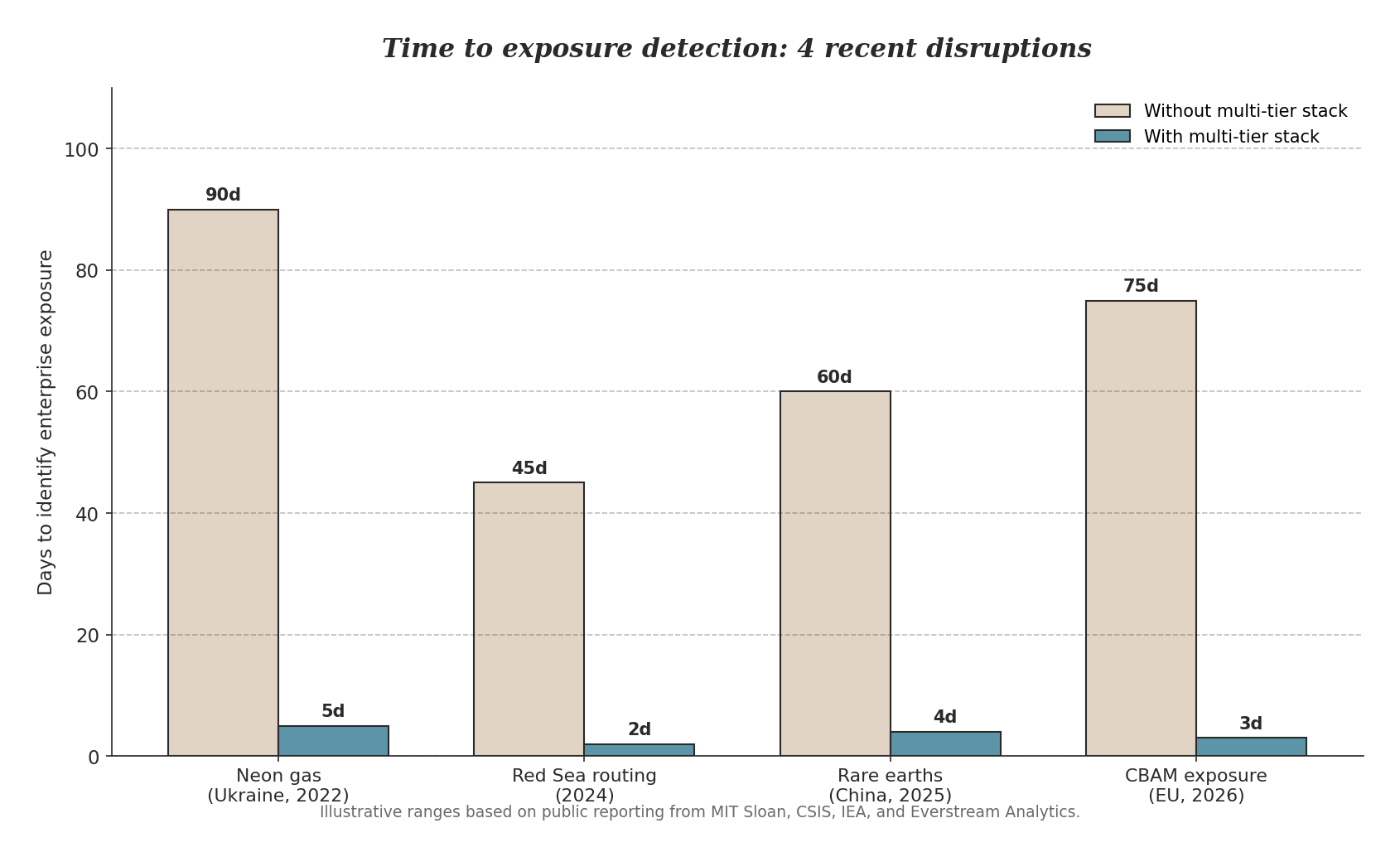
A working illustration: in 2022, enterprises with multi-tier visibility identified neon gas exposure within days of Russia's invasion of Ukraine, where two Ukrainian producers — Ingas in Mariupol and Cryoin in Odesa — supplied an estimated 45–55% of all semiconductor-grade neon globally. Competitors without visibility took months to trace the same dependency through their network. The same pattern played out in 2025 with rare-earth magnets: China accounts for 94% of global sintered permanent magnet production, and firms that had pre-mapped that exposure spent days re-costing while others spent quarters discovering it.
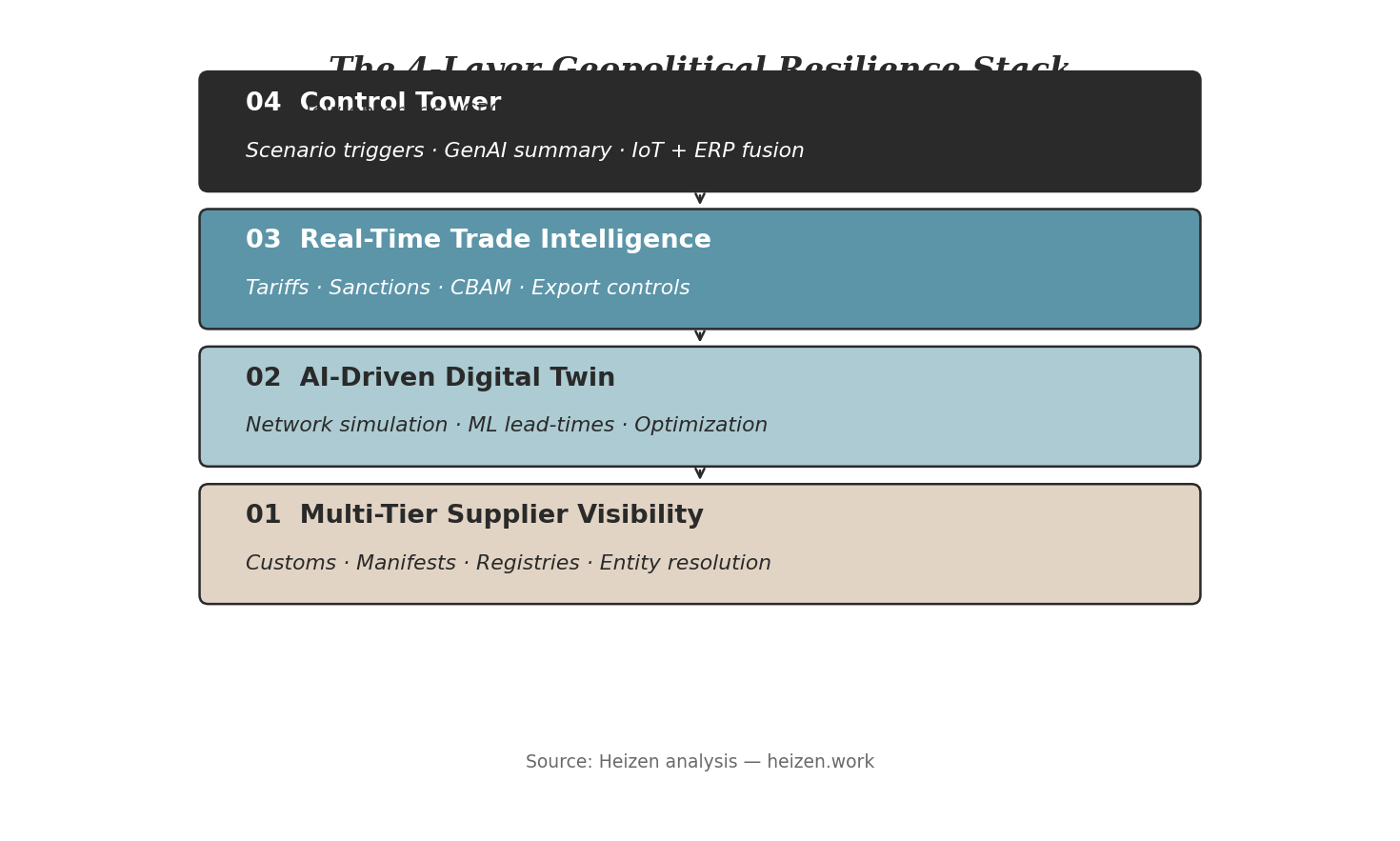
What's emerging is a standard architecture. Four layers, each solving a different question. None of them are new individually. The shift is that they're now wired together and treated as one system.
Layer 1 — Multi-tier supplier intelligence
Multi-tier supplier intelligence is a class of platform that maps the supplier network beyond Tier 1 by combining customs data, shipping manifests, regulatory filings, corporate registries, news feeds, and AI-driven entity resolution. The named vendors here are Interos, Resilinc, Everstream Analytics, and Sayari. Large enterprises increasingly augment these platforms with internal intelligence layers tailored to their own commodity and country exposure — the platform supplies the network graph; the internal layer scores it for the categories that matter most.
The 2022 neon case remains the canonical proof: firms with the graph already built identified exposure within days. Firms without it spent months on phone calls. The same dynamic repeated in 2025: when China's Ministry of Commerce introduced export restrictions on seven rare-earth elements on April 4, 2025, and expanded the list in October to include holmium, erbium, thulium, europium, and ytterbium, the firms with pre-mapped magnet exposure moved into mitigation immediately. Most didn't.
"Multi-tier visibility is no longer a nice-to-have for risk teams; it is the entry point to every other layer."
The honest limitation: data quality below Tier 2 is still messy. Customs records lie, shell companies obscure ownership, and entity resolution is probabilistic. Treat the output as a triaging tool — not as ground truth. The right use is to narrow attention to the 20 supplier paths that warrant a human investigation, not to claim end-to-end omniscience.
Layer 2 — AI-driven digital twins for network design
A digital twin is a computational replica of the physical supply chain — plants, distribution centers, lanes, suppliers, inventory policies — that can be simulated against "what-if" scenarios without disturbing the running operation. The modern twin is AI-augmented: machine learning predicts lead-time distributions, demand shifts, and cost evolution, while optimization engines solve for the best network configuration under a given scenario.
The performance case is now well documented. McKinsey research on supply chain applications shows digital twins delivering up to a 20% improvement in fulfilling consumer promise, a 10% reduction in labor costs, and a 5% revenue lift through optimized operations. The global digital twin market itself was estimated at $35.8B in 2025 and projected to grow at a 31% CAGR through 2033.
The operational case is simpler: a digital twin turns a three-week consulting exercise into a three-hour simulation. A CPG leader can ask "what does our network cost and service-level look like if tariffs on Category X rise to 40%, CBAM obligations bite in Q3 2026, and we shift 30% of sourcing from China to Mexico and Vietnam?" and get a quantified answer the same day.
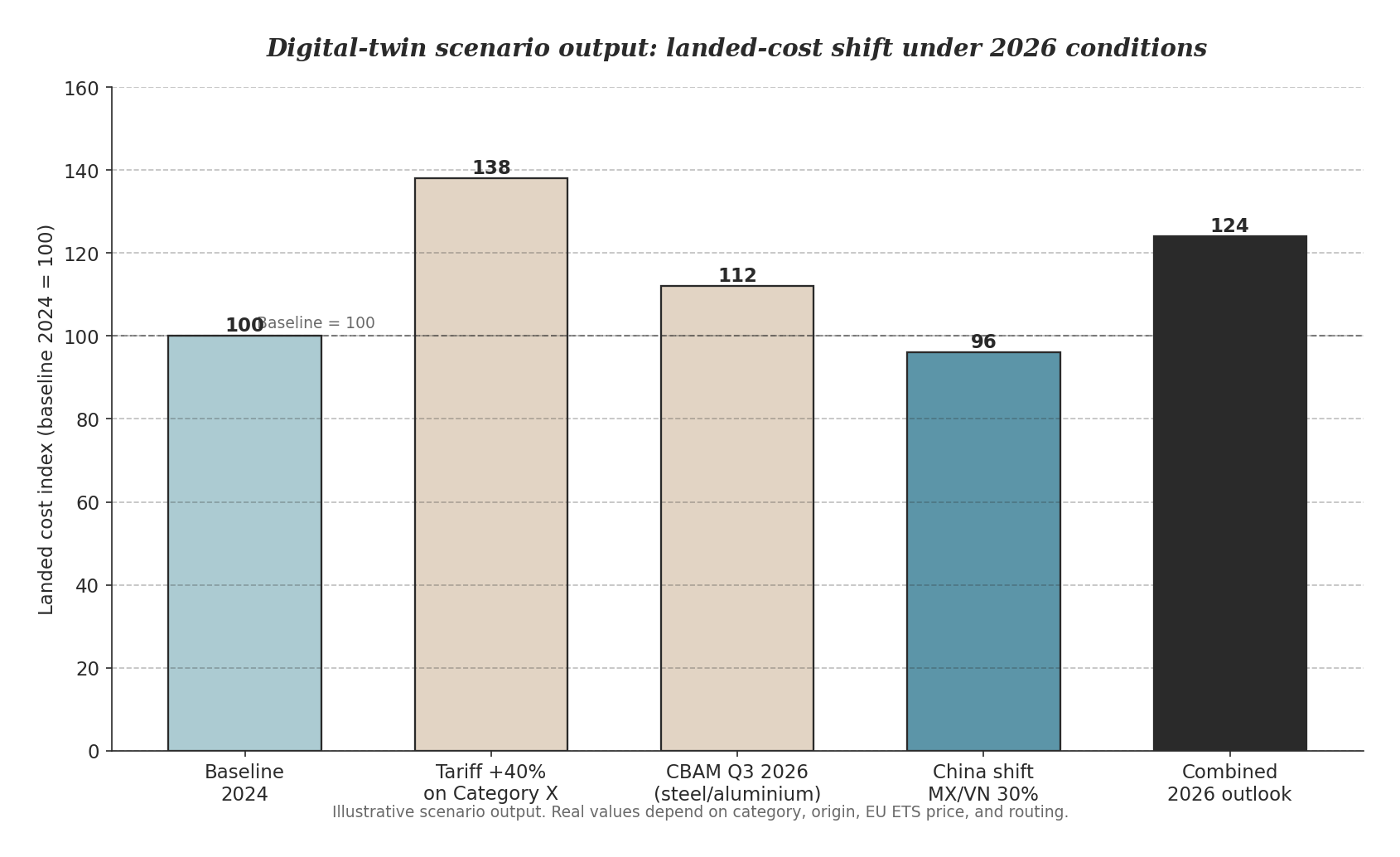
The trap is buying the platform before owning the data. A twin run on stale master data and unreliable lead-time signals produces confident, wrong answers — which is worse than no answer. Get layer 1 mature first.
Layer 3 — Real-time trade and regulatory intelligence
Real-time trade intelligence is a class of AI system that ingests tariff schedules, sanctions lists, export-control changes, CBAM rules, and country-specific regulatory updates, then maps them onto the actual SKU-origin-destination flows in the network. When a new tariff drops, the system identifies affected flows, quantifies the landed-cost impact, and flags the product-market combinations where the change tips the sourcing economics.
This layer matters now because the regulatory surface is moving faster than humans can read. CBAM became financially binding on January 1, 2026 — importers must now purchase and surrender CBAM certificates to cover embedded emissions in cement, iron and steel, aluminium, fertilisers, electricity, and hydrogen. Total CBAM costs for aluminium alone could surge from €1B to €4.7B by 2030, with the heaviest impact falling on exporters with carbon-intensive grids. Add China's rotating export controls — officially suspended in November 2025 for one year until November 2026 as part of a US-China trade agreement, but the underlying licensing levers retained — and the cadence is now weekly, not annual.
The right test for this layer is simple: when the next rule changes, can your system tell you which SKUs cross the affected origin–destination pair within an hour? If not, the layer isn't wired.
Layer 4 — Control towers with scenario triggers
A scenario-triggered control tower is a real-time network view that combines IoT telemetry, carrier APIs, and ERP data, layered with generative AI summarization so executives read plain-language situation reports rather than interpret dashboards. The difference between a 2015-era control tower and a 2026-era one is the ability to trigger scenarios: when a risk signal crosses a threshold, the control tower automatically runs a pre-defined scenario in the digital twin and surfaces the recommended response.
This is the layer most often bought first and most often disappointing. Gartner notes that 23% of AI control tower projects stalled in 2025 due to a lack of cross-functional alignment. The reason is structural: a control tower without a digital twin underneath it is a dashboard. A control tower without multi-tier visibility feeding it is a dashboard with prettier alerts. The control tower's value is the orchestration — and orchestration requires the other three layers to be real.
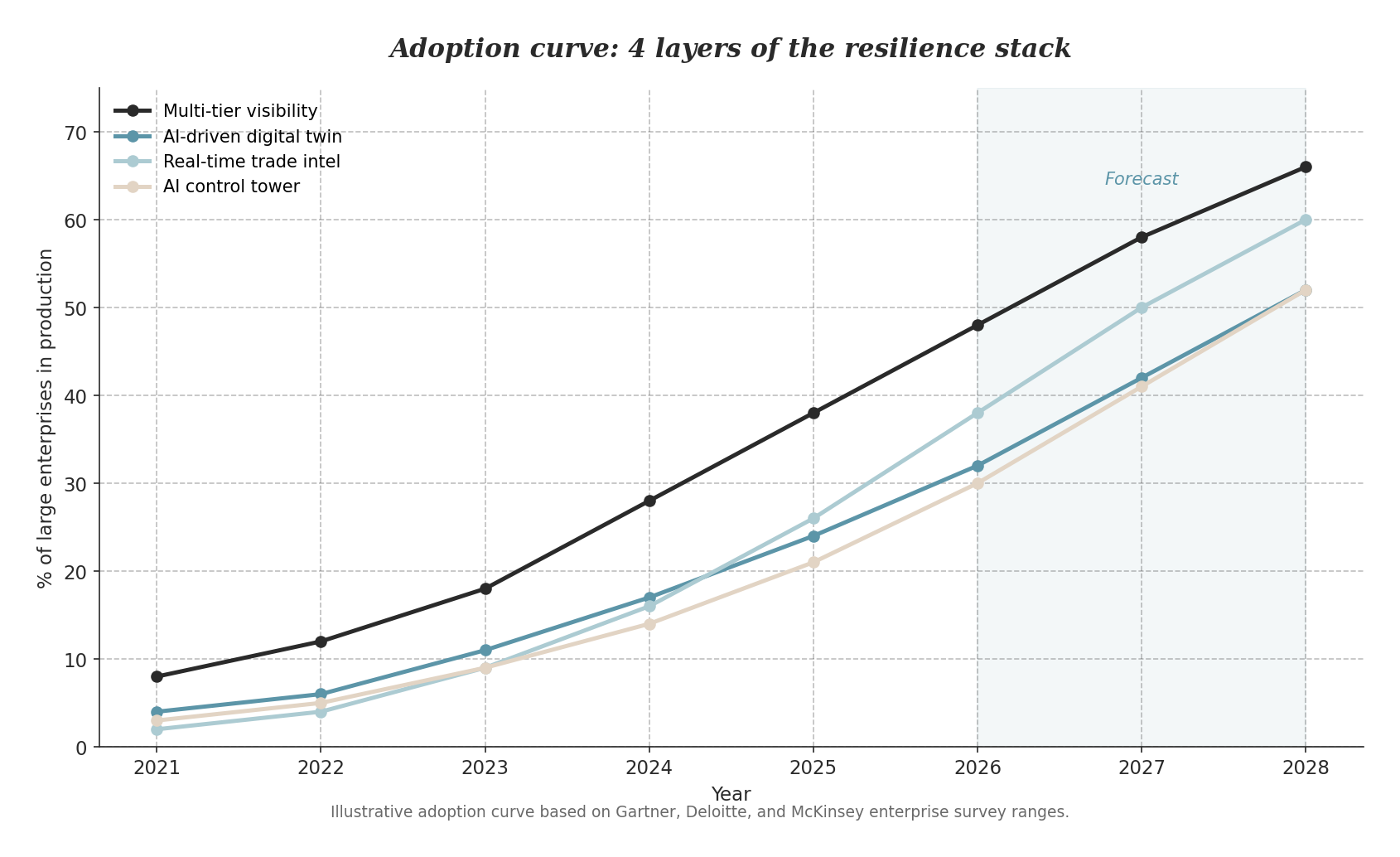
The teams getting value treat the control tower as the thinnest layer in the stack, not the headline one. The intelligence lives in layers 1–3. The control tower just decides what to surface, when, to whom.
The order matters more than the vendor
Most enterprise supply chain transformations are paid for in the wrong sequence. The control tower is bought first because it demos well. The digital twin is bought second because consulting firms recommend it. Multi-tier visibility is bought third, often after a disruption. Trade intelligence is bought fourth, usually under finance pressure.
The build order that actually works is the inverse. Multi-tier visibility first — it's the data foundation everything else stands on. A minimum-viable digital twin second, built around the categories where supply concentration risk is highest. Trade intelligence third, wired into the twin. Control tower last, and intentionally thin.
Heizen is an AI-native software delivery company that builds supply chain systems for enterprise CPG and manufacturing companies. The pattern we see most often in our work with operators is the same one Gartner is documenting at scale: the platforms are available, the data sources are accessible, the AI is capable. The constraint is sequencing. Teams that sequence the stack right move into action while their competitors are still in discovery.
The geopolitical environment is not going to get simpler in the back half of the 2020s. The stack is the lever that lets supply chain teams compress the gap between signal and response — and that gap is now the operating margin.


