


Supply chains can see disruption earlier than ever. The new competitive gap is how quickly procurement can turn that signal into an approved action.
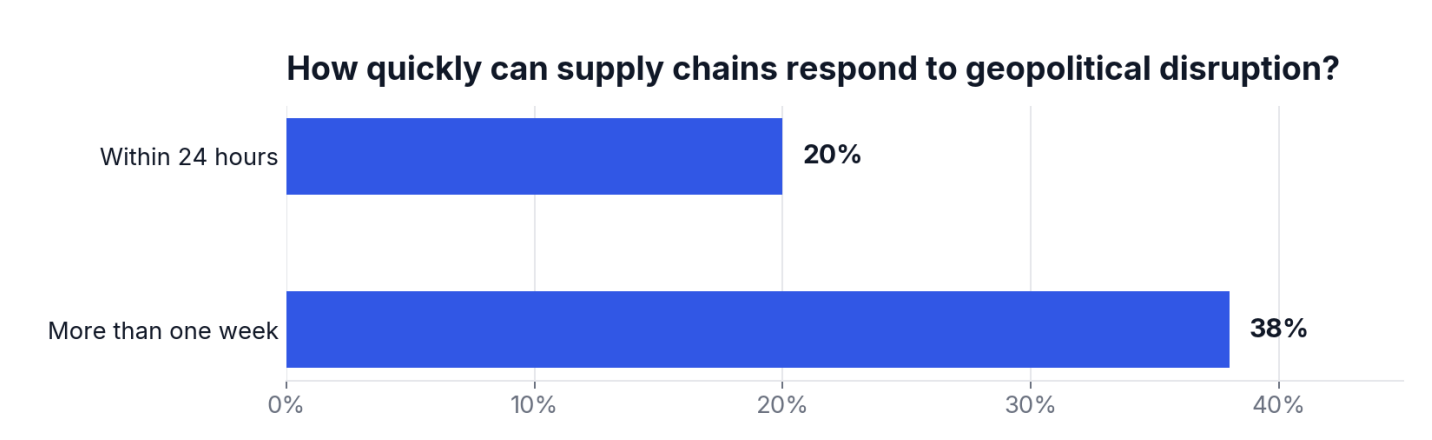
Only 20% of supply chain leaders can respond to a geopolitical disruption within 24 hours. 38% need more than a week.
That gap captures one of the most important procurement problems of 2026. Companies have spent years building visibility through ERP systems, supplier platforms, control towers, risk monitoring and forecasting. They can often spot a risk early. What they still struggle with is moving from insight to action before the window closes. The emerging bottleneck is procurement decision latency: the time between identifying a supply chain risk or opportunity and executing an approved response. In a more volatile market, that waiting time is becoming a direct business cost.
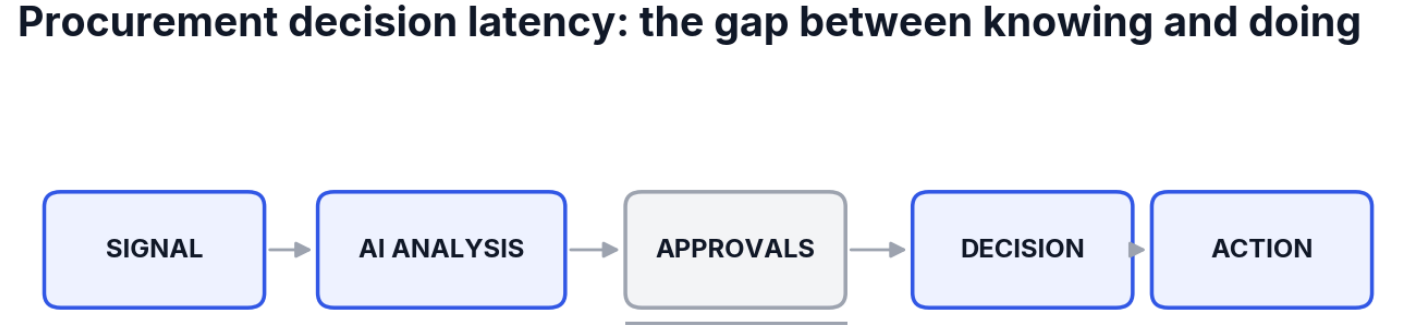
Visibility is no longer enough The World Economic Forum's Global Risks Report 2026 ranks geo-economic confrontation as the leading near-term global risk. The report points to tariffs, sanctions, restrictions on strategic resources and the weaponization of supply chains as part of a more fragmented operating environment. Half of surveyed experts expect the next two years to be turbulent or stormy. [2] At the same time, S&P Global says late-2026 supply chain risk is shifting beyond geographic chokepoints toward scarce materials, constrained components and compressed decision time. [3] The implication is simple: seeing a disruption is useful only if the business can act while capacity, inventory and alternative suppliers are still available.
Imagine a critical supplier shows signs of disruption. A modern procurement stack may already know current inventory, contracted volume, historical pricing and alternative sources. AI can analyze those signals in minutes. Then the recommendation enters the organization: procurement reviews it, finance calculates the impact, operations checks capacity, quality verifies specifications, legal reviews obligations and leadership approves the change. By the time the decision is final, the best alternative may already be gone.
Agentic AI can compress the loop - but only to a point
Traditional analytics told procurement teams what happened. Generative AI increasingly helps explain what it means. Agentic AI goes further by executing parts of a multi-step workflow: monitoring supplier risk, identifying alternatives, preparing RFQs, analyzing bids, reviewing contracts and routing recommendations for approval.
The efficiency upside is meaningful. McKinsey estimates agentic AI could improve procurement efficiency by 25% to 40%, primarily by shifting time away from transactional work and toward strategic activity. Adoption is also moving beyond experimentation: the 2026 Procurement Executive Insight Report from The Hackett Group and GEP says 17% of organizations report moderate-to-large-scale agentic AI deployment and another 44% are actively piloting it.
But giving AI the ability to recommend a decision is easier than giving it authority to execute one.
The real bottleneck is governance
Suppose an AI agent finds an approved supplier offering the same component at an 8% lower price. It can probably request a quote automatically. It may be able to negotiate within predefined boundaries. But should it shift crores of purchasing volume without a human sign-off? That is no longer a model performance question. It is a governance question.
BCG's July 2026 research on agentic AI in tech procurement found that 71% of respondents cited trust in autonomous decision-making as a barrier. Security and IP risk followed at 66%, regulatory uncertainty at 57%, accountability at 53% and auditability at 48%.
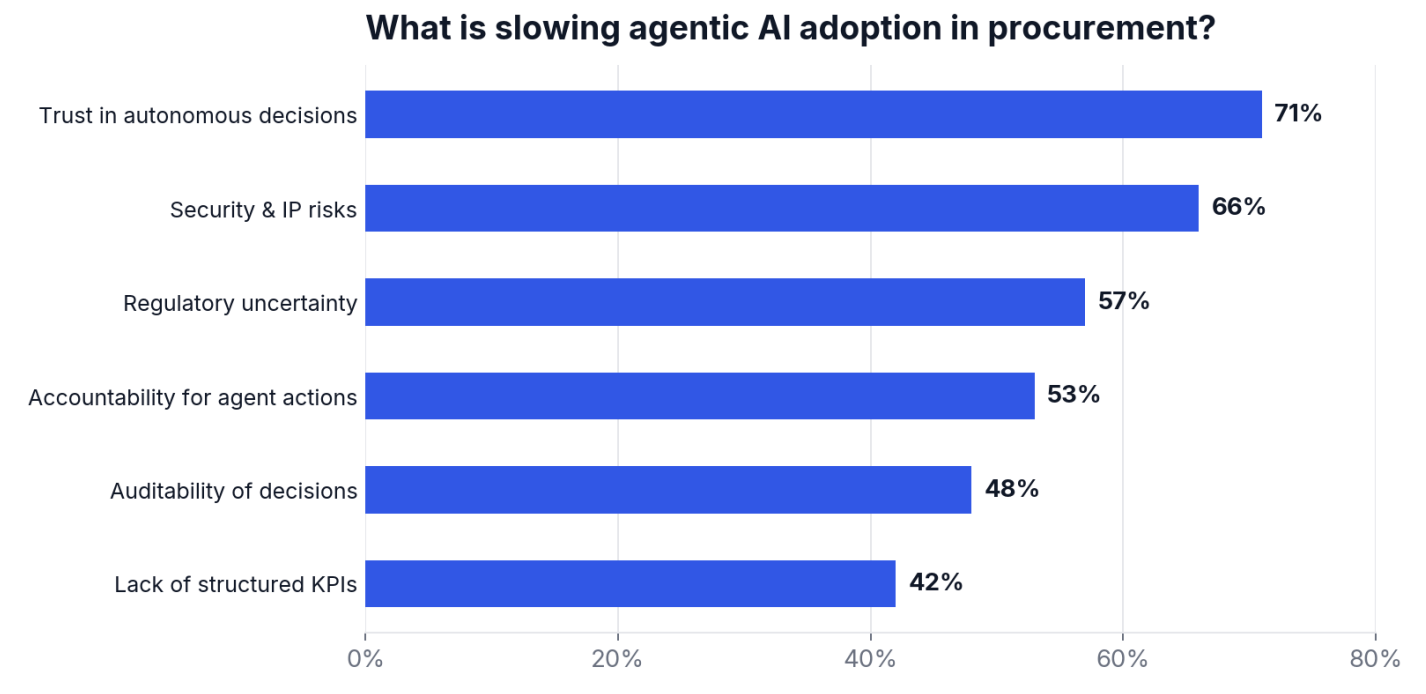
The lesson is that procurement transformation now requires decision architecture, not just better software. Organizations need explicit rules for what an agent can do independently, what financial or risk thresholds trigger human review, and who remains accountable when an autonomous workflow acts.
Data is the unglamorous prerequisite
Autonomy also exposes a more basic weakness: fragmented procurement data. Supplier information may be split across ERP systems, spreadsheets, emails, PDFs and contract platforms. The same vendor can appear under multiple names. Category structures differ across business units. Contracts remain unstructured. An AI agent does not make these problems disappear; it can simply make a bad decision faster.
The 2026 GEP/Hackett research identifies data quality as the key barrier to scaling agentic AI. It also reports that only 43% of purchasing categories have proactive risk monitoring on average, leaving most categories managed reactively. The companies best positioned for autonomous procurement may therefore be the ones with the cleanest supplier master data, strongest integrations and clearest business rules - not merely the newest AI models.
The KPI procurement may need next: Time-to-Decision
Procurement already tracks savings, supplier performance, sourcing cycle time, contract compliance and working capital. In a volatile environment, it may need to measure one more thing: Time-to-Decision - the elapsed time from a meaningful supply chain signal to an executed business response.
A supplier-risk alert should quickly become a sourcing decision. A commodity-price movement should become a negotiation decision. A demand spike should become an inventory decision. A logistics disruption should become a routing decision. The shorter those loops become, the more valuable the original insight becomes.
For the last decade, supply chain technology focused on helping companies see problems sooner. The next phase is about connecting signal, decision and action. Because in 2026, the scarce resource in procurement may no longer be information. It may be decision time.


