


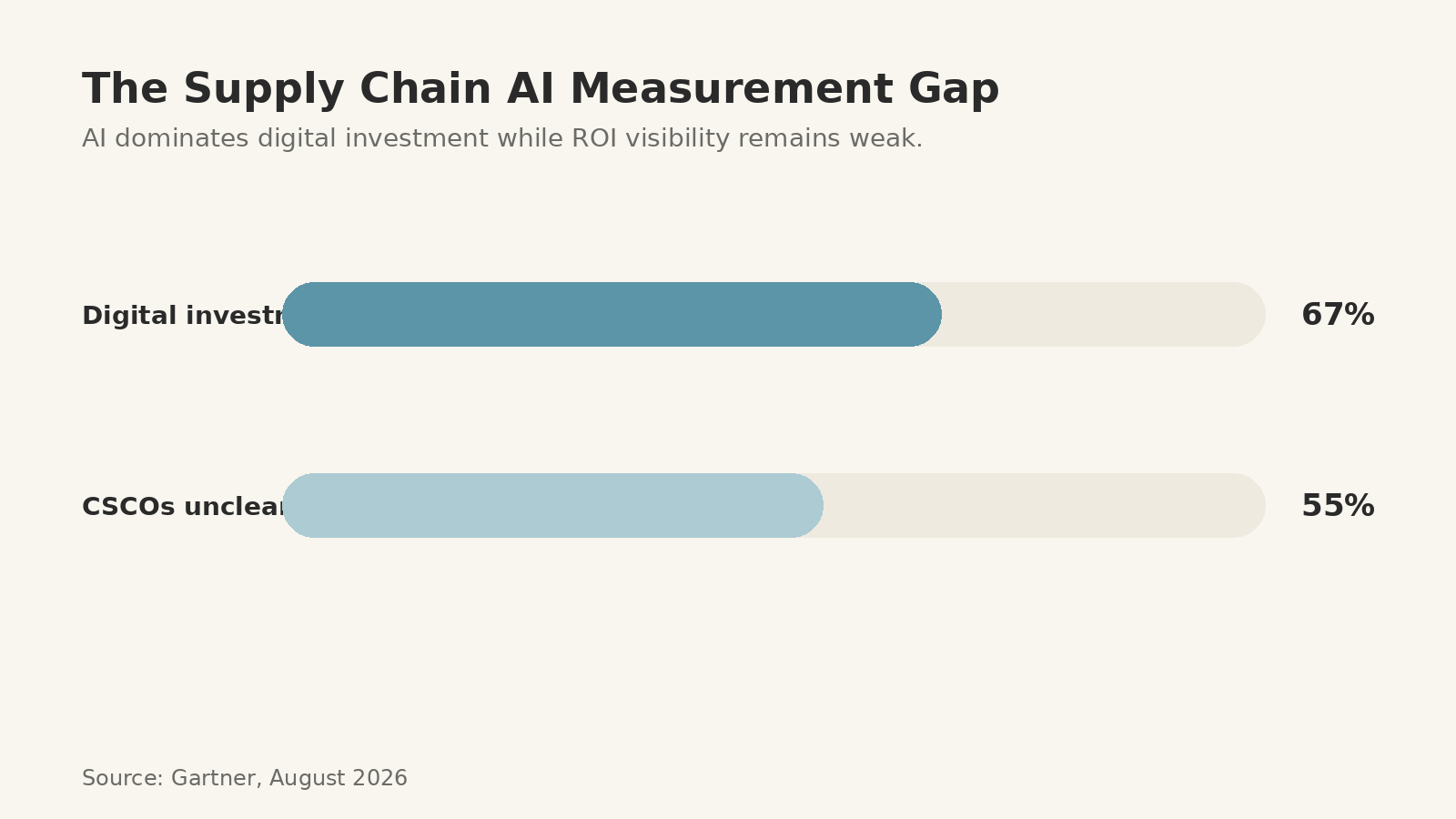
Two-thirds of supply chain digital budgets now flow toward AI. Yet more than half of supply chain leaders still cannot clearly measure what those investments return.
Artificial intelligence has moved remarkably quickly from an experimental line item to one of the largest areas of digital investment inside the supply chain. What has not moved at the same speed is the ability to prove its economic impact.
Gartner’s August 2026 research highlights that disconnect clearly. Around 67% of supply chain digital investment is now allocated to AI, while 55% of Chief Supply Chain Officers say they remain unclear about the ROI of those investments.
That does not necessarily mean supply chain AI is failing. It points to a different problem: enterprises are becoming better at deploying AI than they are at isolating, attributing and measuring the value AI creates.
For supply chain leaders, that distinction matters. As AI investments grow, the next phase of adoption is unlikely to be defined simply by which company has the most models, copilots or agents. It will increasingly be defined by which companies can connect those systems to measurable operational outcomes.
The ROI Problem Is Not Primarily a Model Problem
When an AI initiative struggles to demonstrate ROI, the natural response is often to question the technology. Perhaps the model was not accurate enough, the data was inadequate or the use case was insufficiently mature.
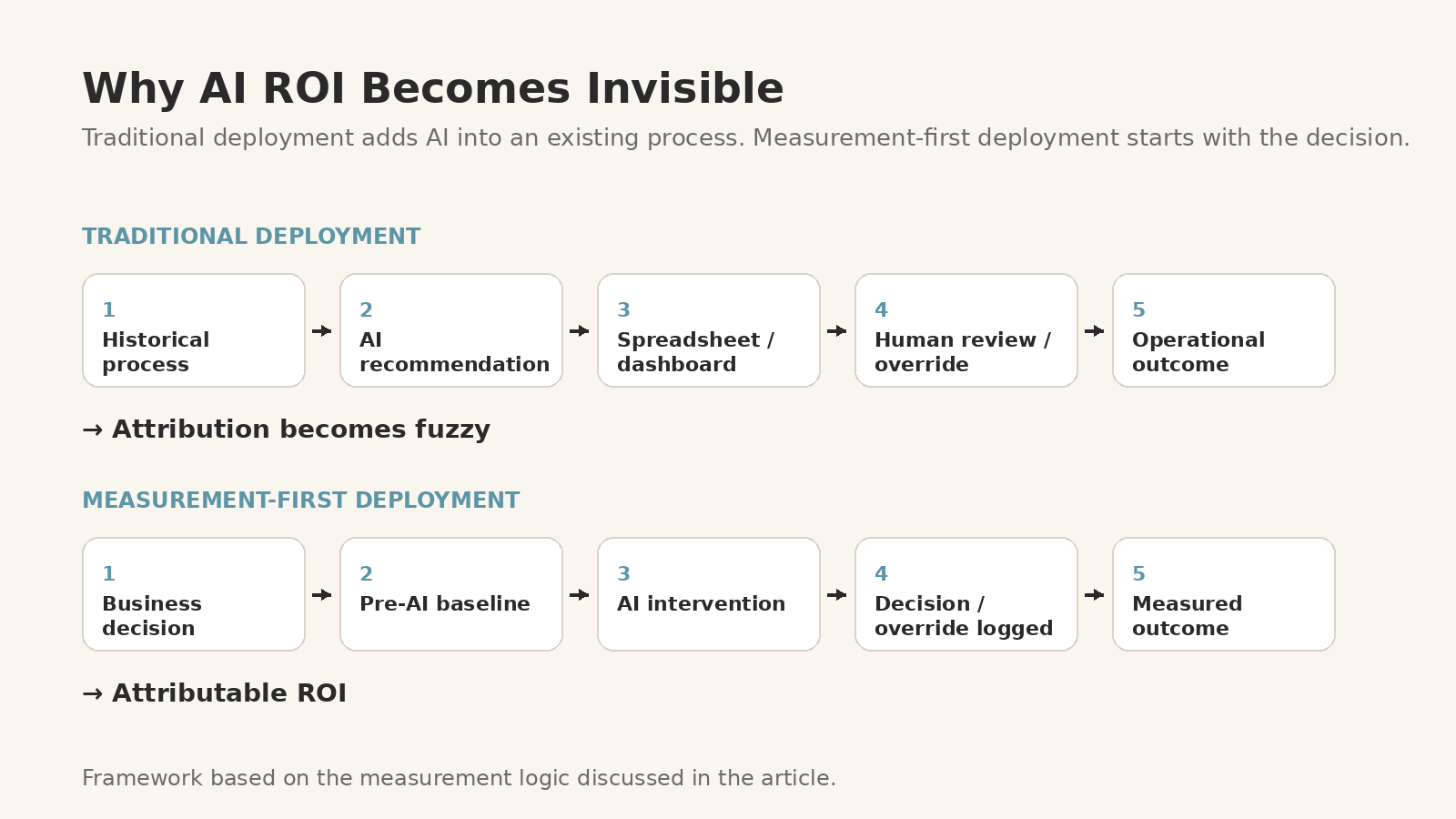
Those issues certainly exist, but Gartner’s research suggests that the larger constraint is increasingly organizational. AI is often deployed on top of an existing workflow rather than being used to redesign the decision that workflow exists to support. A demand planning team gets an AI forecast. A procurement function receives supplier recommendations. A planner gets a new predictive dashboard. A manager gets automatically generated summaries.
Yet underneath these new interfaces, many of the operating mechanics remain largely unchanged. The same approvals remain in place. The same exceptions are escalated manually. The same planning cadence continues. Teams continue to export information between systems, spreadsheets remain somewhere in the process and human overrides are rarely measured consistently.
The organization has introduced AI into the workflow, but the workflow itself has not necessarily become AI-native. That makes attribution extremely difficult.
Imagine that inventory falls by 6% following the implementation of an AI forecasting system. The business knows the outcome improved, but proving why it improved is much harder. Was forecast accuracy responsible? Did demand stabilize? Were recommendations frequently overridden by planners? Did supplier lead times improve? Were safety-stock policies changed during the same period?
Without a clear baseline and decision-level instrumentation, the value may be real while remaining almost impossible to attribute directly to AI.
Putting intelligence into a process does not automatically make the process intelligent.
Legacy Systems Make the Measurement Problem Worse
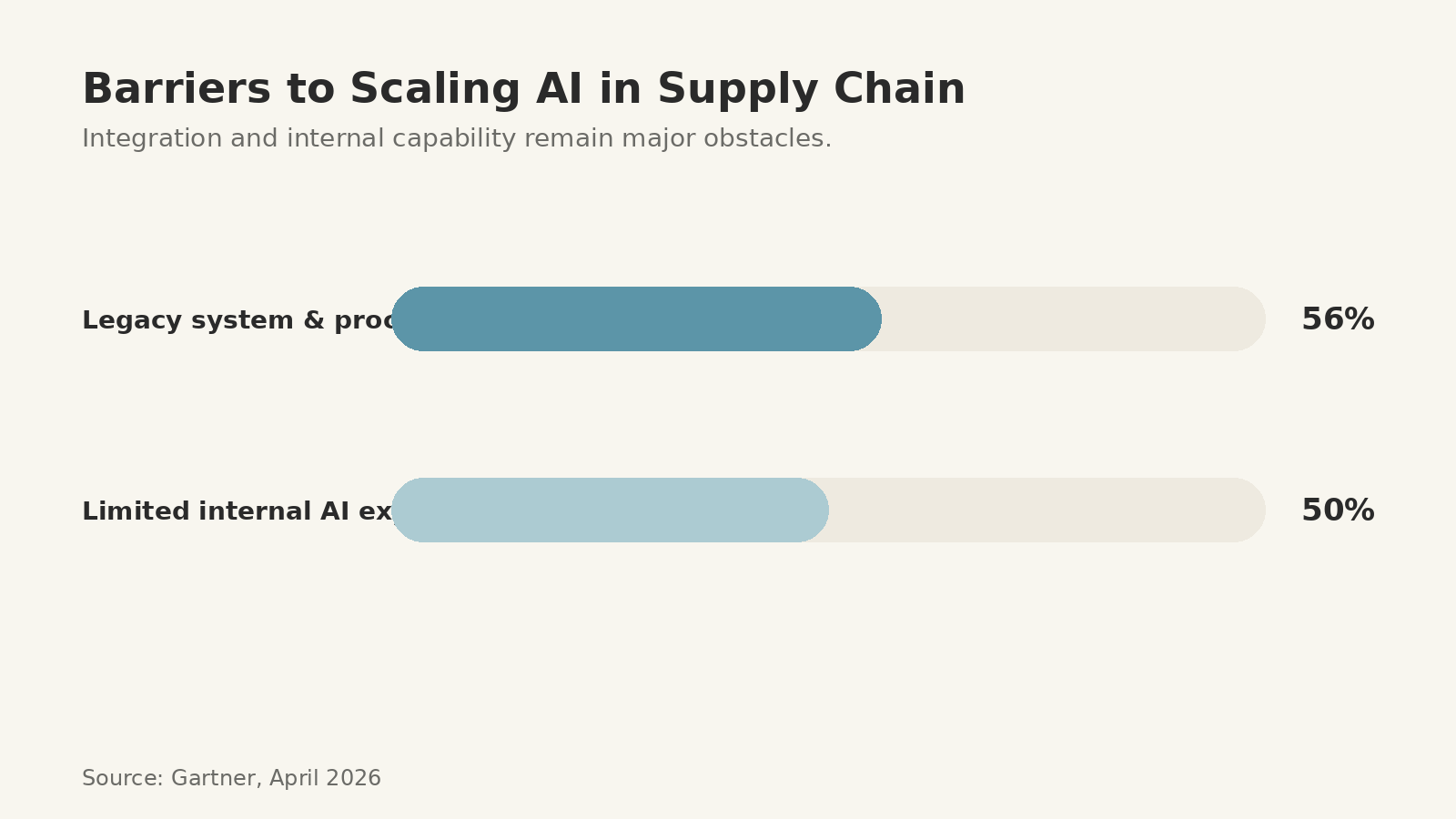
Gartner’s April 2026 research found that 56% of CSCOs identified integration with legacy systems and processes as a major challenge, while 50% cited limited internal expertise to implement and manage AI.
These are not isolated technology problems. They directly affect an enterprise’s ability to understand where AI begins and where the existing operating process ends.
McKinsey’s broader enterprise AI research points toward the same mechanism. Only 39% of organizations report any EBIT impact attributable to AI, while roughly 21% of organizations using generative AI have redesigned at least some workflows around it.
The common thread is workflow design. If an AI system generates a recommendation that is exported into another platform, reviewed manually, altered in Excel and eventually approved by somebody who may or may not use the recommendation, the causal chain becomes extremely difficult to measure.
The AI might have influenced the outcome. But influence is different from attributable financial return.
Measure the Decision, Not the AI
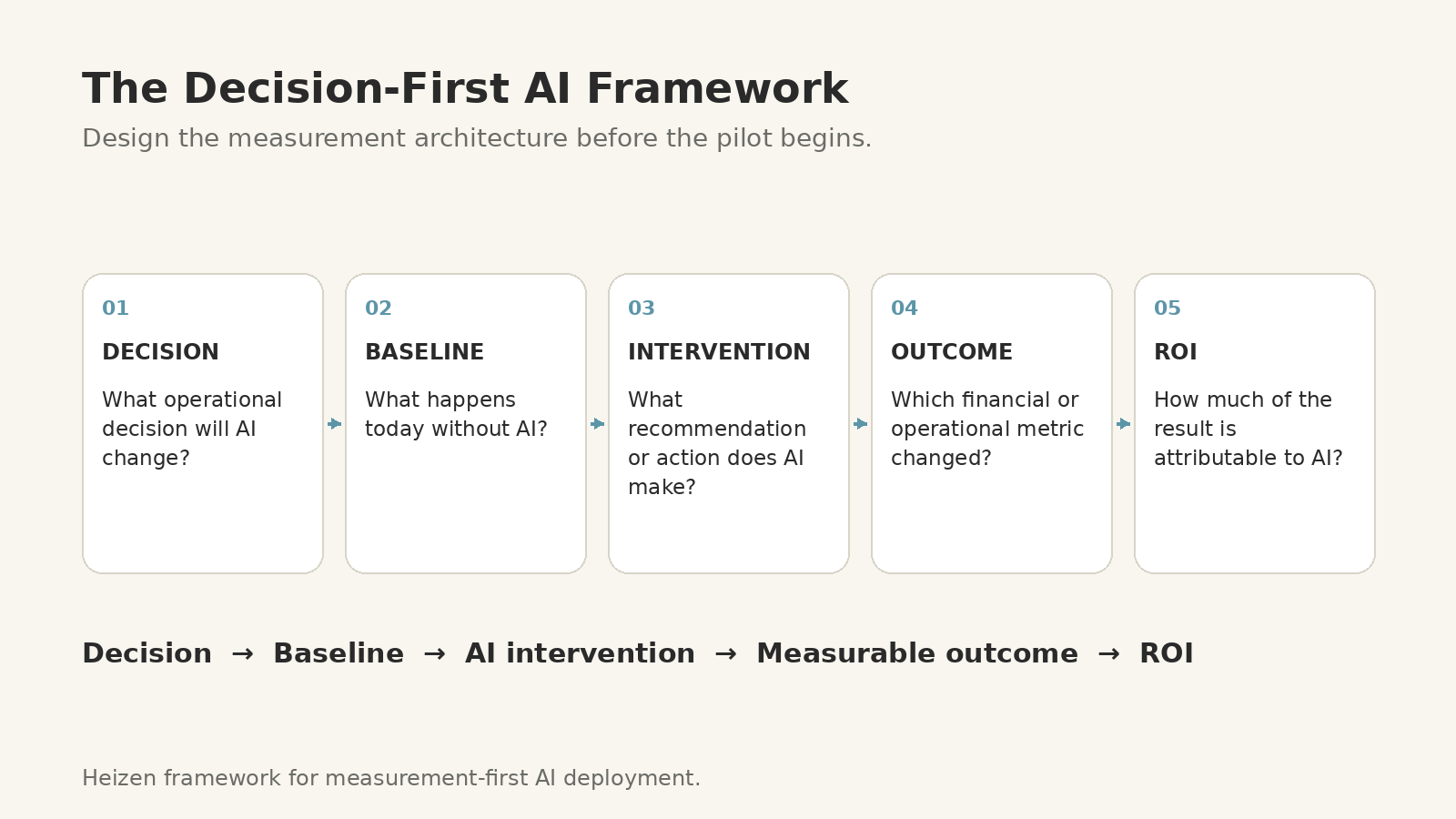
One way enterprises can simplify this problem is by changing the question asked at the beginning of an AI initiative. Instead of starting with “Where can we use AI?”, start with “Which business decision are we trying to improve?”
In supply chain operations, that decision might involve whether a particular SKU should be reordered, how inventory should be allocated between distribution centres, which supplier should receive a purchase order, how much demand should be expected during a promotion or which shipment is likely to miss its service commitment.
Once the decision is clearly defined, the economics become much easier to measure. A forecasting system can be evaluated against forecast error, stockouts and working capital. An inventory allocation system can be measured against service level and inventory days. Procurement intelligence can be connected to cycle time, purchase-price variance or supplier performance. Logistics systems can be evaluated using transportation cost, expedite spend or OTIF performance.
The critical step is establishing those measurements before the AI system goes live. If ROI measurement begins only after a pilot has been completed or when the renewal decision reaches procurement, the enterprise has already lost much of the evidence needed to establish causality.
Beware the Dashboard Trap
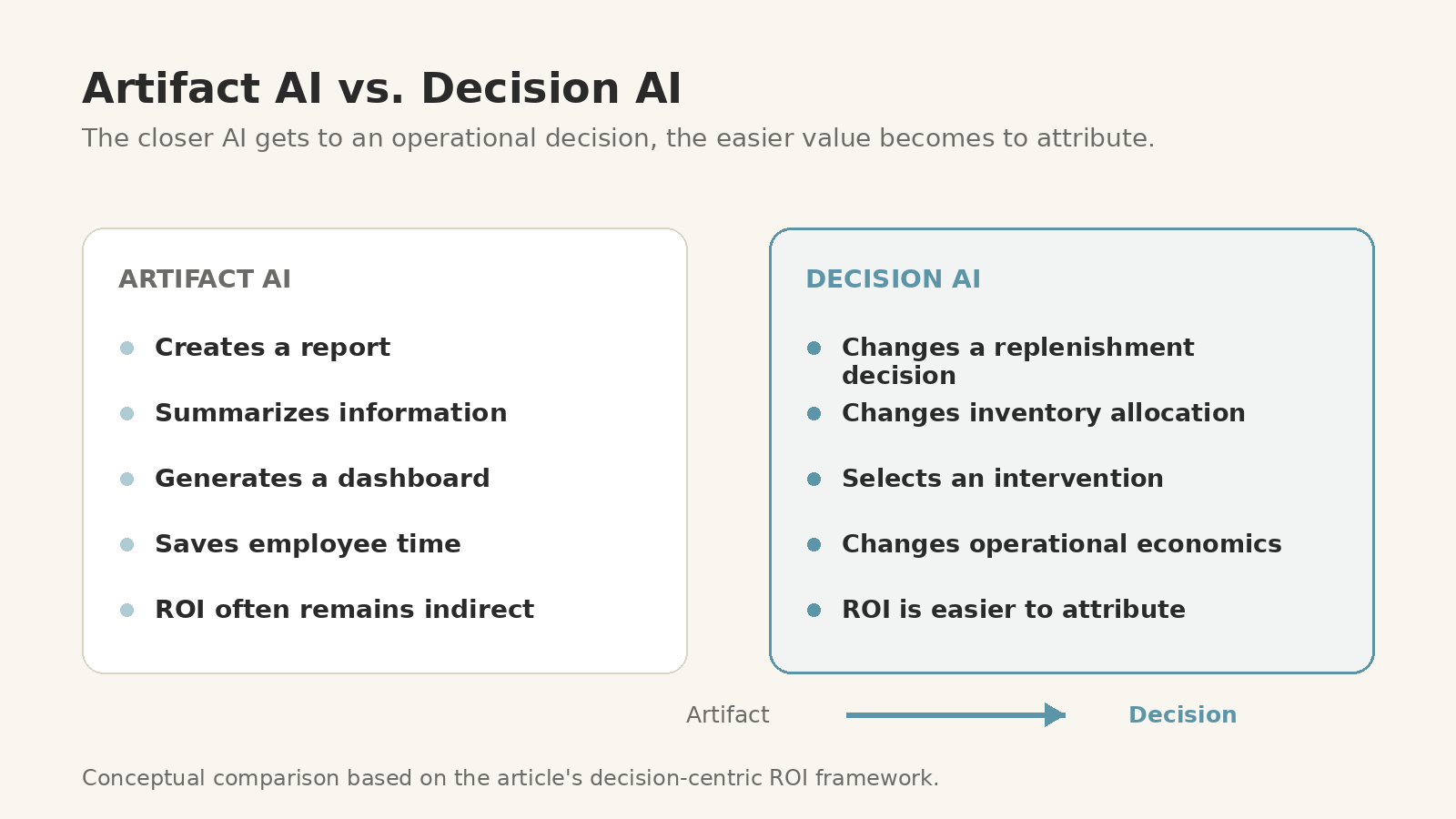
This also creates an important distinction between AI systems that automate artifacts and systems that improve decisions.
A significant amount of enterprise AI activity still focuses on creating reports, generating summaries, producing dashboards, drafting emails or accelerating analysis. These systems can certainly improve productivity, but productivity gains become difficult to translate into enterprise value unless they materially change the downstream operational decision.
Compare that with an AI system directly influencing replenishment. If the system allows the organization to reduce average inventory by three days while maintaining the same service level, the economic impact can be calculated. Or consider an AI agent monitoring logistics exceptions. If it identifies high-risk shipments early enough to reduce expedite costs by 12%, the value is directly connected to an operational metric.
The closer AI gets to the actual decision, the cleaner the path from technology to financial impact becomes.
Agentic AI Could Change the Equation
This question becomes even more important as supply chains move from AI systems that recommend actions to AI systems capable of executing them.
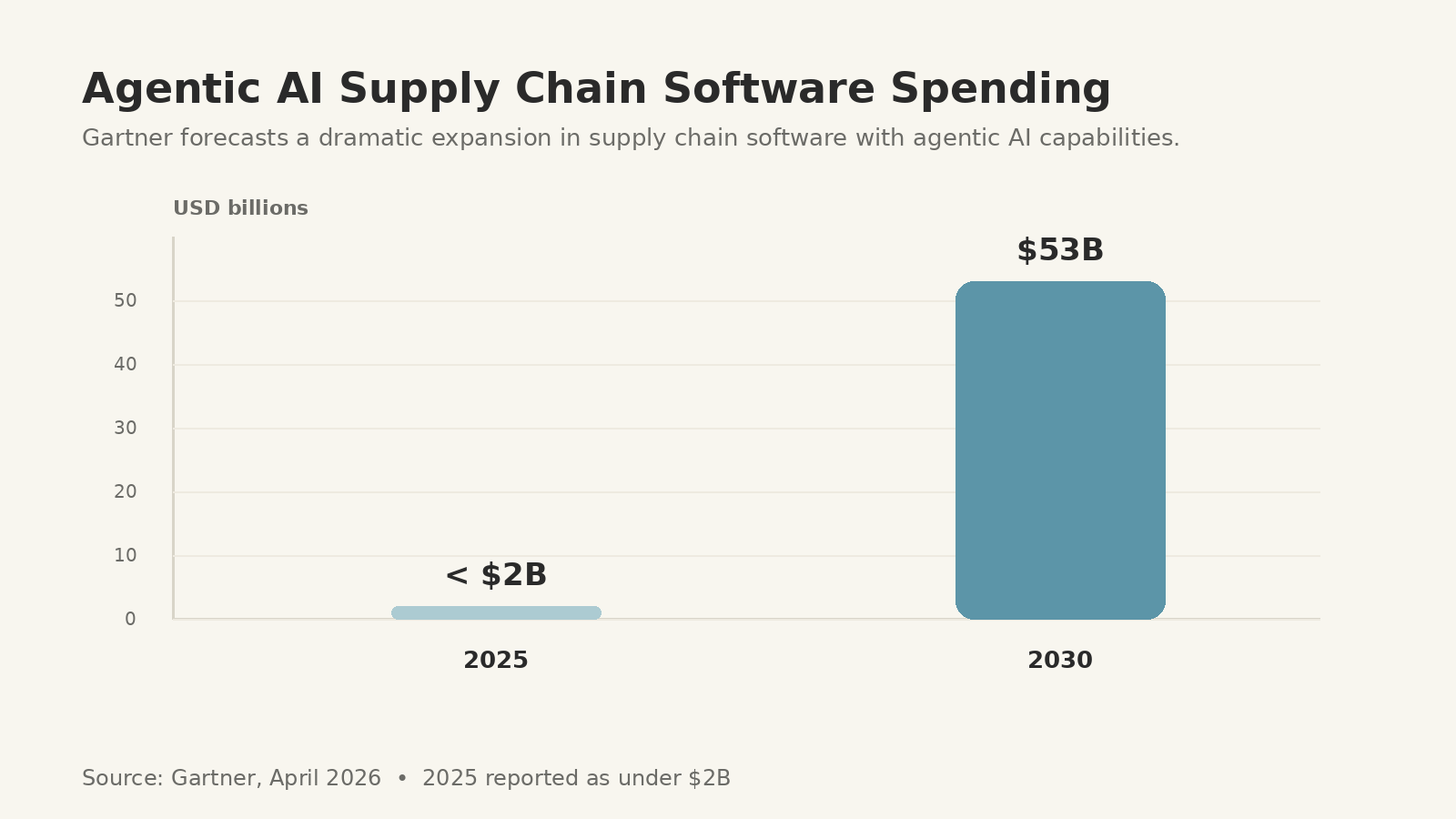
Gartner forecasts that spending on supply chain management software with agentic AI capabilities could grow from less than $2 billion in 2025 to $53 billion by 2030.
That shift is significant because an agent behaves differently from a traditional analytics or recommendation system. An agent can potentially generate an order, adjust inventory allocation, trigger a workflow, communicate with a supplier or escalate an exception without waiting for a human to initiate every step.
There is an obvious risk here: badly designed processes could simply become automated faster. But there is also an enormous measurement opportunity. Agent actions can be logged. Decisions can be timestamped. Human overrides can be captured. Downstream outcomes can be associated with specific interventions.
For perhaps the first time, AI systems may actually make it easier to construct a measurable chain between machine action and operational outcome, provided that measurement is designed into the system before deployment.
Change Management Is Becoming AI Capital Allocation
Gartner’s findings also suggest that organizations may need to rethink what change management means in an AI-heavy operating environment. Traditional enterprise change management often focuses on helping employees adopt one major system or process. AI creates a different problem because organizations could simultaneously be running dozens or even hundreds of AI initiatives competing for employee attention, training resources, workflow redesign and executive sponsorship.
Change capacity is finite. That means leaders increasingly need to determine which AI initiatives actually deserve that capacity.
Gartner predicts that organizations that appropriately rightsize change-management efforts around AI could achieve twice the ROI of companies continuing to rely on legacy, one-size-fits-all change methodologies by 2030.
That reframes change management from an implementation activity into something closer to capital allocation. Enterprises need to decide which AI initiatives influence valuable decisions, which require meaningful behavioural change, which deserve executive sponsorship and which experiments should simply be stopped.
What Supply Chain Leaders Should Watch Through 2027
The first signal will be whether the gap between AI spending and ROI visibility begins to close. If investment continues growing while measurement remains weak, the conversation inside enterprises will eventually change. CFOs and boards are unlikely to remain satisfied with the number of AI pilots launched or models deployed. They will increasingly want to know which systems have changed revenue, margin, working capital, service levels or cost.
The second signal will be workflow redesign. Companies that simply add AI onto existing processes may continue struggling to establish defensible ROI. Organizations willing to redesign decision rights, exception paths and planning processes around AI should find attribution considerably easier.
The third will be whether measurement moves upstream. The strongest AI implementations will define the attributable metric before the pilot begins, rather than trying to reconstruct the business case after deployment.
At Heizen, this is an increasingly important principle when building AI-native systems for enterprise CPG and manufacturing environments. The objective should not simply be to place AI inside a workflow. The software, operating process and measurement layer need to be designed together so that the resulting business impact can actually be observed.
That becomes especially important as enterprises transition from AI that generates insights toward AI that increasingly participates in operational decisions.
The Real AI ROI Question
The uncomfortable conclusion from Gartner’s research is not that supply chain AI is failing. It is that many organizations genuinely do not know whether it is succeeding.
Two-thirds of the supply chain digital budget is already moving toward AI while 55% of the leaders responsible for those investments cannot clearly measure their return.
Models will improve. Agents will become more capable. Implementation costs will decline. The technology itself will continue moving forward. Measurement will not improve automatically.
Every enterprise AI initiative should therefore be able to answer four things: what decision the system changes, what metric that decision should improve, what the baseline looked like before deployment and how much of the subsequent improvement can reasonably be attributed to the AI system.
If those answers do not exist, the organization may not yet have an AI ROI problem. It has a measurement design problem.
And as AI absorbs a larger share of the supply chain technology budget, that is becoming an increasingly expensive problem to ignore.


