


A working accounting of which replenishment decisions execute unattended today, which still wait for a person, and why the gap is governance — not algorithms.
Autonomous replenishment is a class of supply chain AI in which software agents continuously monitor inventory, demand, and supplier signals, then execute reorder, reroute, and rebalancing decisions without waiting for human approval. The phrase appears on nearly every planning-software roadmap circulating in the enterprise market. The reality inside most operations is narrower: a handful of decisions genuinely run unattended, a larger set runs on a human's one-click confirmation, and the highest-value decisions still route to a planner every time.
That distinction matters more than the marketing suggests. The question a supply chain leader should ask a vendor is not "is it autonomous?" but "which specific decisions execute without a person, under what conditions, and who is accountable when one is wrong?" The honest answer in 2026 is that autonomy is real but bounded — concentrated in high-volume, low-consequence reorder decisions, and thinning fast as the stakes of any single decision rise. Understanding where that line sits is the difference between deploying autonomy that compounds and buying a co-pilot you've been told is a pilot.
What actually runs without a human today
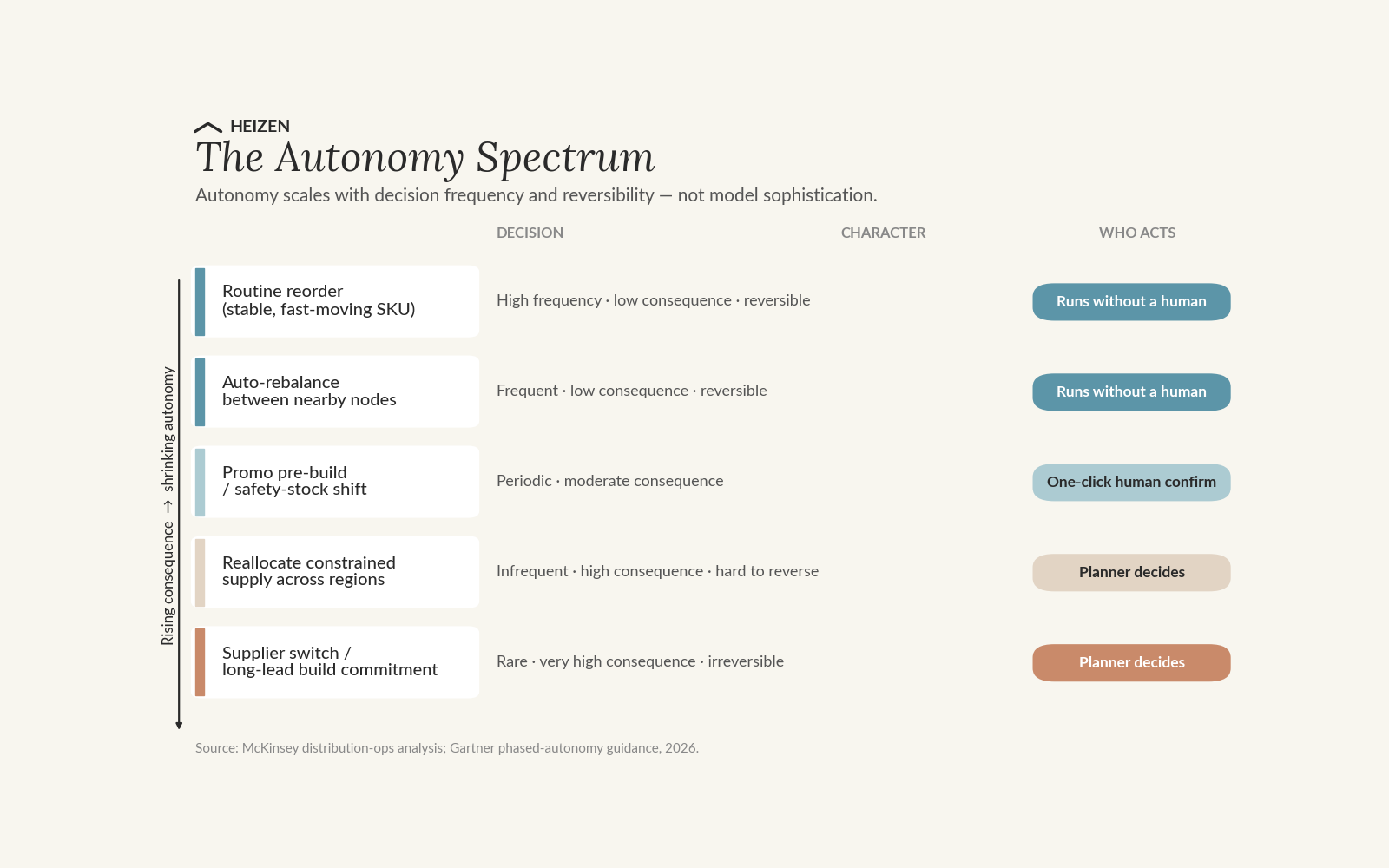
The decisions that genuinely execute unattended share three traits: they are high-frequency, individually low-consequence, and reversible. Routine reorder-point replenishment for fast-moving, stable-demand SKUs is the clearest example. When an agent has clean sell-through data, a reliable lead time, and a supplier under contract, it can place the purchase order, confirm it, and adjust the next cycle's quantity with no planner in the loop — and it does, in production, at scale.
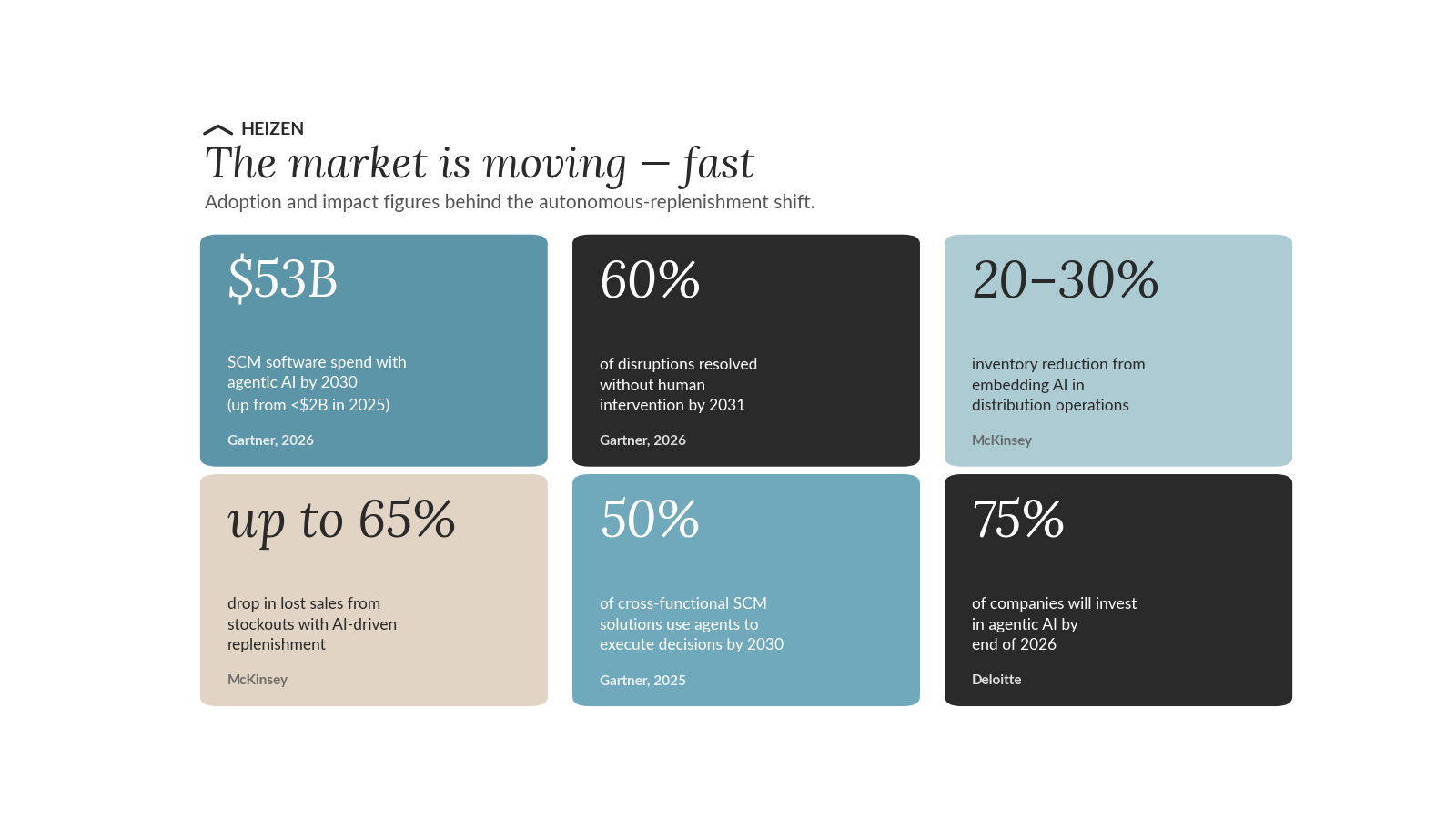
This is not speculative. McKinsey's analysis of AI in distribution operations finds that embedding AI can cut inventory by 20 to 30 percent and reduce lost sales from stockouts by up to 65 percent, gains that come precisely from letting the system act on demand signals faster than a weekly planning cycle allows (McKinsey). Ocado's grid-based fulfilment centres push this further, with agents continuously monitoring stock and triggering replenishment automatically as predicted demand draws down — automation that orchestrates thousands of robots without a human authorizing each move.
The common thread is bounded risk. A wrong reorder on a stable, fast-moving SKU costs a few days of carrying cost and self-corrects on the next cycle. That is the zone where full autonomy is not just possible but already the better operator.
Why the human stays in the loop where it matters
The human is still in the loop on high-consequence decisions because the cost of a single bad call exceeds the efficiency gained from removing the approval step. This is structural, not a temporary maturity gap that one more model release closes.
Consider the decisions that still route to a planner: a large pre-build ahead of a promotion, a reallocation of constrained supply across regions, a supplier switch during a disruption, a build commitment on a long-lead component. Each is low-frequency, high-consequence, and hard to reverse. The math that makes autonomy obvious for routine reorders inverts here — the expected cost of one wrong autonomous decision dwarfs the cumulative labour saved by automating the approval.
Gartner's own guidance reflects this. Its analysts recommend that current data and technology maturity restrict full automation to low-risk decisions, using AI to augment human judgment on higher-stakes calls rather than replace it (Gartner). The trajectory is real — Gartner predicts 60% of supply chain disruptions will be resolved without human intervention by 2031, and that by 2030, 50% of cross-functional supply chain solutions will use intelligent agents to autonomously execute decisions (Gartner). But "by 2031" is the operative phrase. The line moves outward as data quality and governance mature, not as a single capability switches on.
"Autonomy scales with how reversible the decision is — not how smart the model is."
That is the whole game. Autonomy scales with the reversibility of the decision and the quality of the data underneath it, not with the sophistication of the model on top.
What the industry isn't saying out loud
The uncomfortable truth is that "autonomous" is sold at the system level but delivered at the decision level — and the two are routinely conflated. A platform marketed as an autonomous supply chain is, on inspection, autonomous for a defined band of decisions and assistive for the rest. There is nothing wrong with that. The problem is that buyers are sold the system label and then discover the decision-level boundaries during implementation, after the budget is committed.
The spending tells the story of how fast this is moving regardless. Gartner forecasts that supply chain management software with agentic AI capabilities will grow from less than $2 billion in 2025 to $53 billion by 2030 (Gartner), and Deloitte projects 75% of companies will invest in agentic AI by the end of 2026 (Deloitte). That capital will buy real autonomy. It will also buy a lot of dashboards relabelled as agents.
The second-order effect most teams underestimate is governance debt. Every decision you make autonomous is a decision you must now monitor, audit, and be able to override and explain after the fact. Autonomy doesn't remove the planner's work so much as move it — from making the decision to defining the conditions under which the machine is allowed to, and watching the edges where those conditions break. The operations that succeed treat autonomous replenishment as a sequencing problem before a software problem: which decision, in which window, with which authority, and with what trip-wire back to a human.
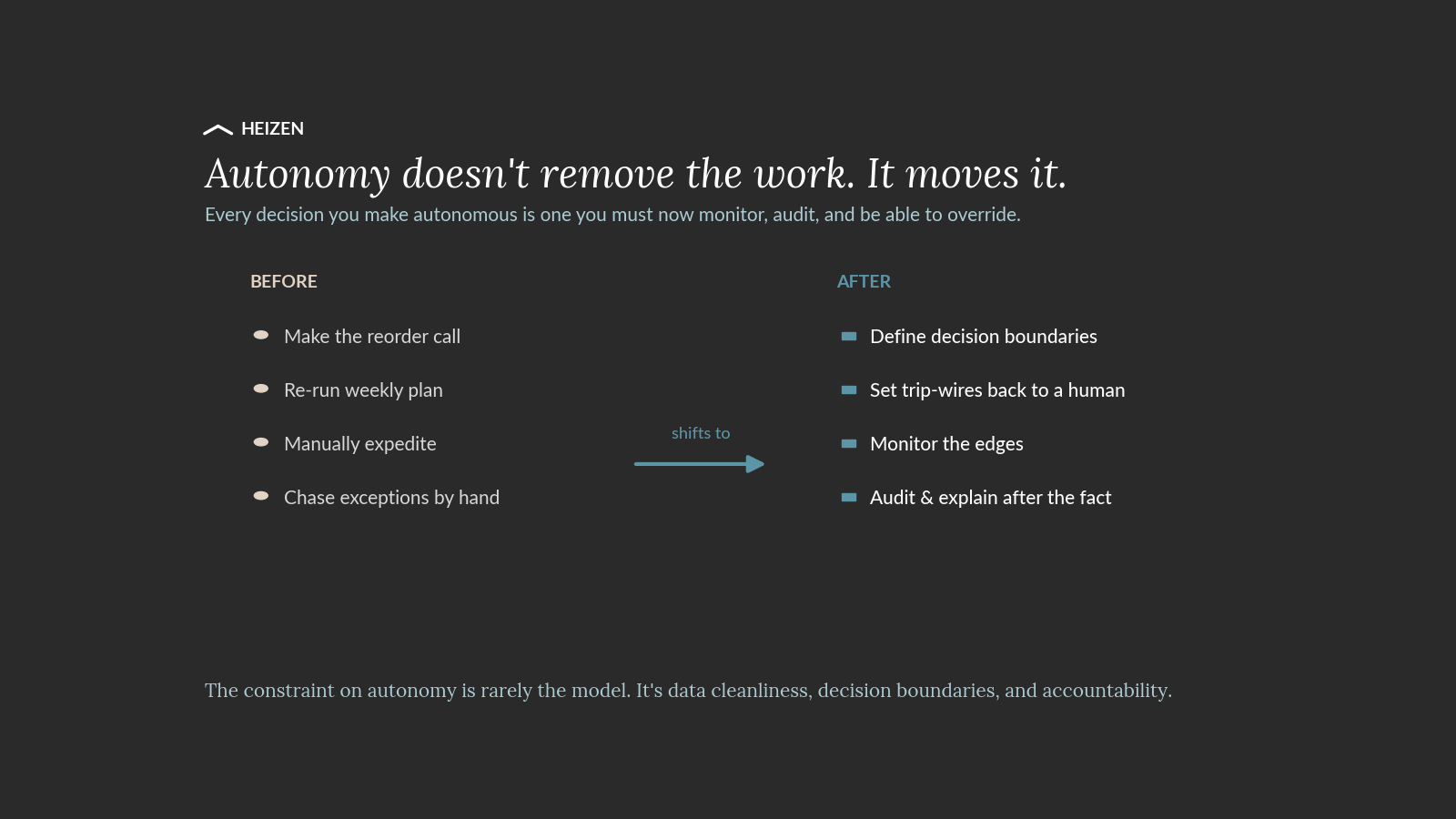
Heizen is an AI-native software delivery company that builds supply chain systems for enterprise CPG and manufacturing companies, and the pattern shows up in nearly every deployment — the constraint on autonomy is rarely the model. It's the data cleanliness, the decision boundaries, and the accountability structure around them. Get those right and a surprising share of replenishment runs without a human. Get them wrong and "autonomous" becomes a button a planner clicks a thousand times a day.
So when a roadmap promises autonomous replenishment, the useful follow-up is not whether it works, but where it stops — and whether the people who own the outcome agreed to the line.


